The Spanish Army marched in Donostia, protected by the Ertzaintza 17/07/07
In the occasion of the Day of Carmen and unlike last year, that marched within the military quartering of Loyola, the three branches of the Spanish Army, as well as important representatives of the Civil Guard and the Spanish Police, along with few political representatives, marched in Donostia among the protests of the neighbours of Alde Zaharra and the pro-amnesty movement.
Although only marched a few meters, the great unfolding of the Ertzaintza (Basque autonomous police) and other bodies of the SSF (Spanish Security Force) mirrored the importance of the military act.
Batasuna sees possible to stop the HST thanks to social struggle 18/07/07
Eusebio Lasa and Joseba Permach, members of the Basque pro-independence left executive, stated in a press conference the reinforcement and strengthen of the Basque social struggle against the HST (High Speed Train). Thanks to it, they believe its paralysation to be possible.
They also underlined that the past 27th May elections were a reflection of what the affected towns feel about it "those political formations that have deceived the citizenship by trying to impose the HST have been punished". And those formations that have played "consequently" have won the elections in the affected localities.
The Basque pro-independence left clearly knows that behind this project there are enormous economic and political interests. Moreover, behind this macro-project it is clearly noticeable the "neo-liberal model" of the PNV (Basque Christian democrat party), UPN (right wing Navarre party) and PSOE (Spanish "socialist" party in government).
2 and 5 years imprisonment sentence to fourteen youth accused of collaborating with ETA 19/07/07
The National Hearing has condemned 14 people to 2 and 5 years imprisonment for "collaboration with armedorganisation". The judges have acquitted Garikoitz Urizar, Gorka Rivadulla, Asier Arriola, Sergio Regueiro and Ibon Perez, five of the youth accused. These 19 people were arrested in 2004, and denounced to have undergone tortures. Haritz Totorika, Amaia Urizar, Iker Arzeluz and Aitziber Sagarminaga have been sentenced to 5 years imprisonment. Nagore Bilbao has been the condemned to 2 years and 7 months, and Immaculada Basabe, Mikel Lizarribar, Gaizka Larrinaga, Janire Couceiro, Iñaki Peña, Sonia Martin, Igor Zearreta, Leire Urrutia and Egoitz Fernandez, to two years.
To impose a false end, to hinder a democratic framework 19/07/07
The opinion article of Josu Jon Imaz published last weekend in diverse newspapers has caused a small earthquake in the Basque political scene. The Basque pro-independence left has criticized the terms which the PNV president li3mits the possibilities of a consultation to the Basque society. This article deepens now on those critics.
Beyond the electoral results, we are staking a new departure point that is not seen like a drama in the Spanish state, a new consensus, thirty years later, without the warding of the Franco regime, aided by a true democratic transition, with the participation and the commitment of the Basque pro-independence left. A new political agreement that will regulate and qualify the mechanisms to grant the word to our town, that starting off from the current reality and being flexible in forms and accounting, will contemplate as a base and limit, the democratically expressed free will and of our country.
The PNV plays dirty once again. Preparing a new fraud to the collective opportunity to give a structural and scrupulously democratic solution to the national negation of this Country, to honestly and negotiatedly untie the knot of the conflict and all its consequences.
The PNV has postulated itself, both in the negotiation table as well as publicly, as a loyal partner for a new historical fraud. A long time ago, it signed a strategic contract: to close the doors to national independence. That is its game. In the short term, to bid for the rejection of the process as a particular interest, and in the long one, as already said Imaz: To captivate Spain as a project.
Its scheme to make of the Spanish legality principle a limit to the freely expressed will of the Basque people, to bid for an agreement with the autonomic branches of the state parties in terms of statutory reform, turning the popular consultation into a mere appendix of entertainment and accompaniment.
The Basque pro-independence left does not want to build a process of democratic solutions against the PNV. And it considers that the sensitivity and political culture of the PNV must commit itself with a decisive agreement of guarantees and vocation of durability.
We believe that the word of the Basque people is the base and the limit of a democratic resolution scene and we take the principle of legality as a guarantee and channel of the democratic expression of the popular will, never as a limit or restriction. To take the process as a statutory reform and the consultation as a legitimation of the scheme is simply not to close the wound that feeds the conflict.
The PNV would better leave the imposition of a false end of the conflict and the prevention of a democratic framework scheme aside to make an honest effort to search and build a democratic resolution from the collective. Effort that means the following exercise: To close well an historical cycle of national negation, territorial division and imposition, to close well a cycle of armed confrontation and general suffering, in order to open, with strength, from the accumulation of majority social energies and political change commitments, a scene of peace and democracy.
The PNV continues in their old scheme. Its bid is a bet for the police route and to set the democratic resolution of the conflict aside. This way it assures the mechanisms of political hegemony and individual economy.
There are two reasons that also underlie in PNV's old and updated bid. On the one hand, it means to agree that the historical bid of resistance and struggle of the Basque pro-independence left was right before the shoddy work of thirty years ago and to live it like a drama. Well, the Basque pro-independence left neither needs the PNV to grant it the historical reason, nor wants medals nor political prices for itself. The positioning of the Basque pro-independence left is and will be the defence of a Country that considers itself a nation and that has the right to its free self-determination. Nothing else and neither nothing less.
On the other hand the PNV is scared of a democratic scene because it considers that in that framework the Basque pro-independence left is an option of popular strength, that could dispute the PNV's hegemony, and that building the Basque Country from the transforming left, with policies that will connect with social majorities can take the reins of the country towards national independence. That fear makes the PNV, at times that require great bids and hard decisions, at times of historical ambition and statistical height, to show itself meek, submissive and always by the side of the master of Madrid. Renewing its old bid of feeding the conflict.
Alvarez calls to apply 182.2 article of the Electoral Law 20/07/07
The member of the Basque pro-independence left executive, Joseba Alvarez, brought to collation that all the political parties, with the exception of Aralar, have participated in the management of the Spanish Law of Parties "usurping" , only in Gipuzkoa, to the Basque pro-independence left a total of 95 councils.
It remembered that in Gipuzkoa the Spanish courts "illegalized" 26 candidacies by, and added that as consequence 95 "usurped" seats and town halls of which "65 have already been stolen", 30 are still to be hold.
Alvarez denounced that the PNV is the political party that gains more from this mathematical operation with 23 "stolen" positions, four of them without been occupied yet, followed by EA (Basque social democrats) with "10 completed robberies and three without been completed".
He continued stating that the PSE ("Basque socialist" party) has also taken possession of 12 seats that do not correspond it, waiting to take another one, followed of the PP (spanish right wing party in the opposition) that "has already usurped" the 17 positions for which it was not chosen in the 27th May elections. EB ("Basque" left wing party) has taking 3 "illegitimate" councils.
Alvarez underlined that in Lizartza the PP governs just by 27 votes and by people who "had not even appeared in the list".
Immediately afterwards it exposed the existing difference between Lizartza and Aretxabaleta, since in this last one Aralar (Basque "left" party) has "publicly" announced that will carry out "until the end" the application of article 182,2 of the Electoral Law.
Alvarez ended denouncing that, as a result of the application of the Law of Parties, "the correlation of forces within the city councils has changed". This reality that supposes "a cheated institutional majority", emphasized, opens the way to the consummation of macro projects such as the incinerator plant, the outer port of Pasaia or the High Speed Train.
A police raid in Castelló in search of two presumed members of ETA 20/07/07
The SSF (Spanish Security Forces) are searching for two people consider members ETA in Castelló. The police operative began after one of them left a taxi when detecting a police control. Inside the vehicle, he would have left a bag with material to make bombs.
The taxi driver, surprised by this attitude, went to the Civil Guard control, to give account of what happened.
The search was extended after the taxi driver warned that the man greeted another person in the station where he took the taxi.
London postpones the Euro-order decision after admitting the arguments of the defence 21/07/07
The court of Westminister has delayed the Euro-order decision against Iñigo Albisu, Zigor Ruiz and Ana Lopez to be able to study with precision the arguments presented by the defence among them the possibility of being tortured when arriving to the Spanish state.
The judge who takes the extradition case of these three Basque political prisoners will also consider the new argumentations presented by the defence around the different abuses given within the judicial process. The decision to handing them over to the Spanish state has been therefore postponed until the next 17th August.
Madrid admits that the process "was collapsed" from beginning 22/07/07
The 29th December 2006, a day before ETA exploded a car bomb in the airport of Madrid-Barajas, Jose Luis Rodriguez Zapatero insisted on his messages of optimism towards the dialogue process.
The Spanish Government has taken six months to publicly assume that, as both the political spokesmen of the Basque pro-independence left as well as the own armed organization expressed repeatedly, the so called "peace process" "was collapsed not long after the cease-fire", that began the 24th March 2006. "We could say that never really started; that is the truth: it never really took off", affirms the Spanish home minister. "It had a hesitant beginning and, from then on, things got complicated", added Alfredo Perez Rubalcaba.
28 July 2007


SUPpORT THE CAMPAIGN ASKING FOR THE RELEASE OF ARNALDO OTEGI.

YOU CAN SIGN IT AT THIS WEBSIDE: WWW.ARNALDOASKATU.ORG or send a message.
The under-signed raise the necessity to release Arnaldo Otegi for the reasons exposed next:
1 - We understand that the political interlocution is the basic instrument to maintain the necessary communication to forward alternatives, as well as to debate and negotiate them between the parts involved, in order to be able to articulate the political agreements with which the Basque Country will reach a scene of peace and freedom.
2 - For that reason, we believe that Arnaldo Otegi's imprisonment is a very serious incident, since he is one of the main interlocutors of the Basque pro-Independence Left and, as it is publicly known he has carried out very important work in the search of a democratic solution to the political conflict that suffers the Basque Country.
3 - Consequently, those of us who subscribe this document forward to the public opinion our rejection to Arnaldo Otegi's imprisonment for being a political background measure, and at the same time request his release to the pertinent judicial authorities.
24 July 2007
New phases will be open and the process will continue
EUSKAL HERRIA Step by Step
ASKAPENA's information service, Nº 186
The previous phase is over. The Spanish government neither wanted to negotiate nor knew how to do it. They put the process under so much strain, and so many times, that they managed to broke it. Two negotiating sides (PSOE and PNV) left the negotiating table letting the third one down. Unilaterally ETA decided to finish the truce unilaterally declared by them. The government get back in the failed path of repression, and they dream about reaching a new Anti-terrorist Pact.
The ones who conspire to block the process see their aim reached. The ones who worked hard to get a solution are already suffering the breaking-off consequences. The ones who dreamt about new times feel disappointed and frustrated. Some essential questions raise in this context: And, now? The opportunity we had is definitively lost? We will go back to the starting point in order to start again?
In the following lines we will try to answer these questions. The path we have walked during these year is not useless. It is not possible to go back to the starting point. Even though the phase ended without reaching an agreement, the process keeps on and will keep on. The solution is still far, but more and more closer. Our aim is not short term, we have not give up hope, and these are the information our conviction is based on.
The Spanish society
It fells more and more less motivated in keeping endlessly the confrontation. Due to the long years of the conflict and the different repressive failure strategies, it become convinced that something must be done. According to opinion tolls, more and more Spanish people agree to try new ways leading to resolution. The ones who supported a total war (PP) did not get during the last elections the good results they expected to get. The ones who supported a combined war (PSOE and their servants) did not get good results either. Nobody won; it was their rotten democracy that lost more as it gets more and more abstention.
The Basque society.
The Basque soceity is also very tired seeing that the years pass, and the conflict is unsolved. ETA's violence is strongly criticized by the Basque society, and more and more, State violence too. The ones who support State violence (PNV) were punished by the electorate. The Basque society increasingly think that the so-call transition was a deception and that the autonomic model was a trap; they feel that it is necessary to advance towards a new frame, that our lives and our future is being decided in Madrid regardless of the choice of our people, they feel that there is not separation of powers in Spain, that Euskal Herria is not able to choose.
The number of people who agree to talk with ETA in order to reach an agreement is growing, and so the number of people thinking that it is a political problem that needs political solutions; many people think that the Parties Law means coming back to Franco times and the illegalization process is absolutely unfair. There are also people who hope to recover the Anti-terrorist Pacts against the Basque left, but they are fewer and fewer, and less convinced: previous experience confirmed that these pacts are useless.
The Basque left
They have showed themselves to have an unimaginable capacity to survive. Their leaders are in prison, their headquarter are closed down, their funding are cut, their party is illegalised, their demonstrations are repressed, their activists are marked people? Their predictions and wills are not fulfilled. It is not a majority force, but it is not unimportant either. This force has shown capacity to survive, to regenerate, to renew its leadership, to have a bearing on the political life, to adapt to new situations, to offer political alternatives...
The reason for its strength is clear: the people belonging to it are coherent, and its proposals agree with the will of the people. Anoeta's Proposal (two negotiating tables as a resolution method) any the Anaitasuna Proposal (a self-government for the four territories [within the Spanish State], where the will of the citizens is respected and the pro-independence possibility is not rejected) are ratified. The Basque Left repeat that dialogue and acceptance of the majority's will is the only alternative.
Internationalisation of the conflict
Important steps have been taken in this field, and this conflict has more and more space in the international agendas: the Vatican, the European Union, UN General Secretary mentioned the situation we are living. Many important international voices established guidelines: "It is necessary to pass from the dialogue phase to substantial negotiations" (Nelson Mandela); "Only if all the sides, in equal conditions, are present at the negotiation table, fruitful negotiations are possible" (Gerry Adams); "Dialogue and negotiation are the only tool able to resolve political problems and to build a real peace" (Statement made by six personalities who supported the process); "Conditions must be created so that all the sides take part in the process...It is necessary to deal with the roots of the conflict in order to reach a lasting solution" (Roelf Meyer, South Africa Ministry of Defence during the years when apartheid was overcome); "Try to end up a conflict by repression means to make it even harder" (Matteo Zuppi, San Egidio Community, specializing in mediation).
The meetings that marked the end of negotiations took place at the end of May, and at the same table where ETA and the Spanish government were seated, a large international representation was also present.
Conclusion
In this crucial moment, sad and tense moments too, there are some facts that become more and more clear for the Basque society: The only alternative to process is more process. We are in one point where the dialogue process relies on a more and more solid social base. These months of intense political dialogue have been extremely important for all the ones who take part in it. The agreement has not been reached, but the work shared with the adversary has not been useless.
Even though PSOE had a negative attitude, they know that there is not another way to solve the conflict but to initiate it again. If in a time they though that superficial solutions would work to solve the conflict, now they know that it is useless. The ones committed to the process we need perseverance and courage to keep on persisting with it despite all the opposition and aggressions. The present breaking-off is neither an irreversible end nor a back to the starting point.
ASKAPENA's information service, Nº 186
The previous phase is over. The Spanish government neither wanted to negotiate nor knew how to do it. They put the process under so much strain, and so many times, that they managed to broke it. Two negotiating sides (PSOE and PNV) left the negotiating table letting the third one down. Unilaterally ETA decided to finish the truce unilaterally declared by them. The government get back in the failed path of repression, and they dream about reaching a new Anti-terrorist Pact.
The ones who conspire to block the process see their aim reached. The ones who worked hard to get a solution are already suffering the breaking-off consequences. The ones who dreamt about new times feel disappointed and frustrated. Some essential questions raise in this context: And, now? The opportunity we had is definitively lost? We will go back to the starting point in order to start again?
In the following lines we will try to answer these questions. The path we have walked during these year is not useless. It is not possible to go back to the starting point. Even though the phase ended without reaching an agreement, the process keeps on and will keep on. The solution is still far, but more and more closer. Our aim is not short term, we have not give up hope, and these are the information our conviction is based on.
The Spanish society
It fells more and more less motivated in keeping endlessly the confrontation. Due to the long years of the conflict and the different repressive failure strategies, it become convinced that something must be done. According to opinion tolls, more and more Spanish people agree to try new ways leading to resolution. The ones who supported a total war (PP) did not get during the last elections the good results they expected to get. The ones who supported a combined war (PSOE and their servants) did not get good results either. Nobody won; it was their rotten democracy that lost more as it gets more and more abstention.
The Basque society.
The Basque soceity is also very tired seeing that the years pass, and the conflict is unsolved. ETA's violence is strongly criticized by the Basque society, and more and more, State violence too. The ones who support State violence (PNV) were punished by the electorate. The Basque society increasingly think that the so-call transition was a deception and that the autonomic model was a trap; they feel that it is necessary to advance towards a new frame, that our lives and our future is being decided in Madrid regardless of the choice of our people, they feel that there is not separation of powers in Spain, that Euskal Herria is not able to choose.
The number of people who agree to talk with ETA in order to reach an agreement is growing, and so the number of people thinking that it is a political problem that needs political solutions; many people think that the Parties Law means coming back to Franco times and the illegalization process is absolutely unfair. There are also people who hope to recover the Anti-terrorist Pacts against the Basque left, but they are fewer and fewer, and less convinced: previous experience confirmed that these pacts are useless.
The Basque left
They have showed themselves to have an unimaginable capacity to survive. Their leaders are in prison, their headquarter are closed down, their funding are cut, their party is illegalised, their demonstrations are repressed, their activists are marked people? Their predictions and wills are not fulfilled. It is not a majority force, but it is not unimportant either. This force has shown capacity to survive, to regenerate, to renew its leadership, to have a bearing on the political life, to adapt to new situations, to offer political alternatives...
The reason for its strength is clear: the people belonging to it are coherent, and its proposals agree with the will of the people. Anoeta's Proposal (two negotiating tables as a resolution method) any the Anaitasuna Proposal (a self-government for the four territories [within the Spanish State], where the will of the citizens is respected and the pro-independence possibility is not rejected) are ratified. The Basque Left repeat that dialogue and acceptance of the majority's will is the only alternative.
Internationalisation of the conflict
Important steps have been taken in this field, and this conflict has more and more space in the international agendas: the Vatican, the European Union, UN General Secretary mentioned the situation we are living. Many important international voices established guidelines: "It is necessary to pass from the dialogue phase to substantial negotiations" (Nelson Mandela); "Only if all the sides, in equal conditions, are present at the negotiation table, fruitful negotiations are possible" (Gerry Adams); "Dialogue and negotiation are the only tool able to resolve political problems and to build a real peace" (Statement made by six personalities who supported the process); "Conditions must be created so that all the sides take part in the process...It is necessary to deal with the roots of the conflict in order to reach a lasting solution" (Roelf Meyer, South Africa Ministry of Defence during the years when apartheid was overcome); "Try to end up a conflict by repression means to make it even harder" (Matteo Zuppi, San Egidio Community, specializing in mediation).
The meetings that marked the end of negotiations took place at the end of May, and at the same table where ETA and the Spanish government were seated, a large international representation was also present.
Conclusion
In this crucial moment, sad and tense moments too, there are some facts that become more and more clear for the Basque society: The only alternative to process is more process. We are in one point where the dialogue process relies on a more and more solid social base. These months of intense political dialogue have been extremely important for all the ones who take part in it. The agreement has not been reached, but the work shared with the adversary has not been useless.
Even though PSOE had a negative attitude, they know that there is not another way to solve the conflict but to initiate it again. If in a time they though that superficial solutions would work to solve the conflict, now they know that it is useless. The ones committed to the process we need perseverance and courage to keep on persisting with it despite all the opposition and aggressions. The present breaking-off is neither an irreversible end nor a back to the starting point.
11 July 2007
WHAT HAPPENED IN THE WINGS?
On March 22, 2006, the armed Basque organization ETA announced an indefinite cease-fire that would start on March 24. Fourteen months later, on June 5, 2007, ETA announced the end of the cease-fire and the reopening of the armed struggle at all the fronts, starting at midnight of June 5.
Today, our aim is to inform about what happened in the wings during the months when the miscarried normalization process was open.
Chronology of a new failed attempt
Preliminary.
Since 2000, there have been non official talks between the Basque left and the Spanish PSOE (Socialist Party). In these talks both of them agreed that the point was dealing with a political conflict that needed a political approach.
The indefinite cease-fire.
As a result of these talks, and aiming to facilitate them, ETA announced an indefinite cease-fire. The logic next step would have been an honest dialogue between both sides. Unfortunately what happened was just the opposite. Once deactivated the armed confrontation, PSOE as well PNV put a strategy previously plotted into practice: denature the process by transmitting the public opinion that the process was just a technical one (disarmament of ETA-resolution of the Basque political prisoners issue), at the same time that they intensified the judicial and police harassment against the Basque left. By doing, so equality of conditions was denied to the other side by the one formed by PSOE-PNV, in other words, a shameful manipulation of the good will of the other side in order to erode it, to have it on the ropes, and if possible, to eliminate it.
The first crisis.
As a result of this change by PSOE and the PNV after the truce declaration by ETA the process reached a deadlock within two months. Before May 2006, the talks underwent their first and grave crisis. In order to unblock it, the Basque left tried to reactivate the encounters with the political parties. In that context we have to locate a very closely followed by the mass media meeting maintained by PSOE and Batasuna in a Bilbao hotel. The PSOE leaves the way free so that the phase of negotiation would advance. Nevertheless, the public projection by the media as for the reached agreement was fatal. In the press conference after the encounter - that happened to be positive - the representatives from the PSOE deceived the citizenship. They said that they had attend the talks not to the solve a crisis, but to remember Batasuna "that it had homework to be done". Despite this rude disinformation, the aim was fulfilled since the crisis was surpassed.
The second crisis.
This crisis took place on August 2006. In the 6 July meeting, so widely announced by the media, PSOE as well as Batasuna committed themselves to reach a pre-agreement before the 31st of July. The dates previously agreed were exceeded without reaching the aim. In a press conference Batasuna's spokesmen tlak about the crisis and the blockade. A little later, PSOE and PNV executives gave green light to reach a pre-agreement which should be debated later by all the Basque agents. The crisis is solved with this decision which means a qualitative jump: for the firs time a true political negotiating table among the three interlocutors is formed with the same aim: to give a definitive and political solution to an old political conflict.
Time of intense dialogue and the two rough drafts.
As it was previously agreed, on September 2006 the dialogue among the three sides becomes more intense. Three meetings were held in September, six more in October, and three more in November. It was an intense experience due to the three interlocutors analysis level: Batasuna, PSOE and PNV. The talks were based on two main points: the necessary political bases for a future agreement, and the establishment of a general scheme for the development of the process.
Four questions were approached, the four of which required consensus: the conception of Euskal Herria as a nation, the right to decide, the respect for all the rights and the institutional organization. Formal aspects were also debated: the method and schedule of the multilateral dialogue (previously, Batasuna and PSOE decided to start up the multy-party table before October 2006).
The intense work during these months gave as a result two rough drafts. The first of them saw the light in September; after reaching this rough draft, October was the most positive month, since it was possible to remarkably advance. At the end of this month a second rough draft saw the light; the bases of a possible agreement that would bring the resolution for the conflict appeared in this rough draft.
The hour of the commitments.
The sixth and last meeting of October was decisive. In that meeting, each one of the interlocutors had to define its position. Batasuna alerted that the rough draft contained gaps and ambiguities that could make it very dangerous at the time of being applied. The first two sections about the recognition of Euskal Herria as a nation and the respect for the rights reached the general agreement. The ones related to the right to decide and the territorial organisation caused discords; Batasuna demand that they have to be more precise so that a fraud could not happen at the time of carrying out a change of the status of Euskal Herria, a point that in private talks the three sides considered absolutely necessary.
Important political proposal of the Basque left.
In order to solve the new blockade, Batasuna put on the table a very important political proposal, which means a big effort done by this political party: an autonomy statute for the four territories in the south of Euskal Herria envisaging the right of the citizens to decide for themselves, and not excluding the option of independence if the Basque citizens decide so. The proposal is close to PNV's ideology and agrees with PSOE's proposals made not many years ago.
The contributions that never materialised since the interlocutors left the table.
The blockade.
After knowing Batasuna's proposal, at the end of October the interlocutors committed themselves to write up their own contributions. They never fulfilled their task. During the three meetings held in November, PNV reiterated that it would change not even one a single comma of the second rough draft; and as for the PSOE, it made important reductions relative to the previous compromises. Regarding Batasuna's new proposal, both PSOE and PNV refused to take it into consideration. As a result, Batasuna reduced its exigency level and it proposed an action line shared with them in order to get closer to a situation of autonomy that did not exclude independence. Not even this readjustment of the proposal was taken into account. PSOE and PNV answered with a second refusal that totally blocked the process. Batasuna keep on waiting for the promised contributions that never arrived. The interlocutors left the table and they have not returned.
Today, our aim is to inform about what happened in the wings during the months when the miscarried normalization process was open.
Chronology of a new failed attempt
Preliminary.
Since 2000, there have been non official talks between the Basque left and the Spanish PSOE (Socialist Party). In these talks both of them agreed that the point was dealing with a political conflict that needed a political approach.
The indefinite cease-fire.
As a result of these talks, and aiming to facilitate them, ETA announced an indefinite cease-fire. The logic next step would have been an honest dialogue between both sides. Unfortunately what happened was just the opposite. Once deactivated the armed confrontation, PSOE as well PNV put a strategy previously plotted into practice: denature the process by transmitting the public opinion that the process was just a technical one (disarmament of ETA-resolution of the Basque political prisoners issue), at the same time that they intensified the judicial and police harassment against the Basque left. By doing, so equality of conditions was denied to the other side by the one formed by PSOE-PNV, in other words, a shameful manipulation of the good will of the other side in order to erode it, to have it on the ropes, and if possible, to eliminate it.
The first crisis.
As a result of this change by PSOE and the PNV after the truce declaration by ETA the process reached a deadlock within two months. Before May 2006, the talks underwent their first and grave crisis. In order to unblock it, the Basque left tried to reactivate the encounters with the political parties. In that context we have to locate a very closely followed by the mass media meeting maintained by PSOE and Batasuna in a Bilbao hotel. The PSOE leaves the way free so that the phase of negotiation would advance. Nevertheless, the public projection by the media as for the reached agreement was fatal. In the press conference after the encounter - that happened to be positive - the representatives from the PSOE deceived the citizenship. They said that they had attend the talks not to the solve a crisis, but to remember Batasuna "that it had homework to be done". Despite this rude disinformation, the aim was fulfilled since the crisis was surpassed.
The second crisis.
This crisis took place on August 2006. In the 6 July meeting, so widely announced by the media, PSOE as well as Batasuna committed themselves to reach a pre-agreement before the 31st of July. The dates previously agreed were exceeded without reaching the aim. In a press conference Batasuna's spokesmen tlak about the crisis and the blockade. A little later, PSOE and PNV executives gave green light to reach a pre-agreement which should be debated later by all the Basque agents. The crisis is solved with this decision which means a qualitative jump: for the firs time a true political negotiating table among the three interlocutors is formed with the same aim: to give a definitive and political solution to an old political conflict.
Time of intense dialogue and the two rough drafts.
As it was previously agreed, on September 2006 the dialogue among the three sides becomes more intense. Three meetings were held in September, six more in October, and three more in November. It was an intense experience due to the three interlocutors analysis level: Batasuna, PSOE and PNV. The talks were based on two main points: the necessary political bases for a future agreement, and the establishment of a general scheme for the development of the process.
Four questions were approached, the four of which required consensus: the conception of Euskal Herria as a nation, the right to decide, the respect for all the rights and the institutional organization. Formal aspects were also debated: the method and schedule of the multilateral dialogue (previously, Batasuna and PSOE decided to start up the multy-party table before October 2006).
The intense work during these months gave as a result two rough drafts. The first of them saw the light in September; after reaching this rough draft, October was the most positive month, since it was possible to remarkably advance. At the end of this month a second rough draft saw the light; the bases of a possible agreement that would bring the resolution for the conflict appeared in this rough draft.
The hour of the commitments.
The sixth and last meeting of October was decisive. In that meeting, each one of the interlocutors had to define its position. Batasuna alerted that the rough draft contained gaps and ambiguities that could make it very dangerous at the time of being applied. The first two sections about the recognition of Euskal Herria as a nation and the respect for the rights reached the general agreement. The ones related to the right to decide and the territorial organisation caused discords; Batasuna demand that they have to be more precise so that a fraud could not happen at the time of carrying out a change of the status of Euskal Herria, a point that in private talks the three sides considered absolutely necessary.
Important political proposal of the Basque left.
In order to solve the new blockade, Batasuna put on the table a very important political proposal, which means a big effort done by this political party: an autonomy statute for the four territories in the south of Euskal Herria envisaging the right of the citizens to decide for themselves, and not excluding the option of independence if the Basque citizens decide so. The proposal is close to PNV's ideology and agrees with PSOE's proposals made not many years ago.
The contributions that never materialised since the interlocutors left the table.
The blockade.
After knowing Batasuna's proposal, at the end of October the interlocutors committed themselves to write up their own contributions. They never fulfilled their task. During the three meetings held in November, PNV reiterated that it would change not even one a single comma of the second rough draft; and as for the PSOE, it made important reductions relative to the previous compromises. Regarding Batasuna's new proposal, both PSOE and PNV refused to take it into consideration. As a result, Batasuna reduced its exigency level and it proposed an action line shared with them in order to get closer to a situation of autonomy that did not exclude independence. Not even this readjustment of the proposal was taken into account. PSOE and PNV answered with a second refusal that totally blocked the process. Batasuna keep on waiting for the promised contributions that never arrived. The interlocutors left the table and they have not returned.
Reactions to ETA's press release
ETA announced on the 5th of June that at 12 am on the 6th of June the indefinite cease-fire came to an end. We will not mention the official notice since its content has had an ample echo in the international press. The armed Basque organization justified its decision on the grounds that the conditions to take ahead a peace process did not happen. ETA blamed the Spanish Government not to have fulfilled the previously agreed commitments, in the same way ETA accused the Basque PNV of behaving like a mere PSOE's servant.
After the official notice, the post-electoral pacts went to a second place. The ETA's press release, although everybody had supposed to happen so, provoked an avalanche of reactions with few new elements, and many of them very opportunists. Many political and social agents had scandalously and irresponsibly behaved during the months of the truce. They had been blind, deaf and dumb with the demolishing attitude of the PSOE and the PNV; they did never denounce the non stop aggressions that both parties made in all the fronts to the third interlocutor. It is only now, when ETA is the one to open all the fronts, that they have raised a cry of horror and alarm. We have witnessed another new expression of thought and unique speech: ETA and its accomplices, the Basque patriotic left wing, are the only responsible agents for the failure of the peace process. ETA's enemies have brought to light all the speeches and strategies that they had beforehand prepared. We summarize in this bulletin some reactions that deserve to be taken into account.
The Government of Madrid bets on the repression
President Zapatero made an official appearance on June 5 directing his reflection in four directions: he warned that ETA is wrong again; he also addressed to the Spanish citizenship to keep calm since the situation is under control, according to Mr Zapatero; he also spoke to to the Basque citizenship to explain that he had done everything that was in his hand to obtain Peace; finally, he did asked to the rest of the political forces to be united against terrorism. These explanations are not able to clarify a very serious doubt: a Government who had carried out a great activity before the cease-fire by ETA; why did it change its attitude once ETA interrupted its armed activity?
Zapatero himself gave the answer to this question in an interview on television: he did not try at any moment to solve the political conflict, the only thing that he tried was the end of ETA without making any substantial modification within politics; ETA had to surrender to seductions Zapatero's ways; at the same time, the Spanish Government added that it was going to undertake the strategy of repression against the Basque patriotic left wing (but the question is: has the Spanish government ever interrupted that violent strategy?). What Zapatero had meant was that he was to harden the repressive measures and, saying so he said the truth: Iñaki de Juana, who continued in the Hospital of Donosti, was transferred to the jail of Aranjuez to complete the one year sentence that he has still to serve; the Spanish judge Garzón prohibited to two leaders of Batasuna to travel to South Africa to attend a Congress where they were invited; the spokesman of Batasuna, Arnaldo Otegi was imprisoned once again, new arrests in France, a refugee was transfered from Mexico... In the week from the 11th to the 18th, Zapatero met all the political forces to try to incorporate them to the Antiterrorist Pact that he is reactivating.
The PP bets on repression
Nothing new. The president of the PP accepts the invitation that Zapatero had made to him in order to meet and to approximate strategies in the fight against the Basque fight for independence. In spite of it, he takes advantage of the new situation to continue striking Zapatero. According to the PP, the facts have given the reason to this political party: the only effective strategy to exterminate "the terrorism" consists in closing any route of dialogue and in fighting that claim for independence with all the possible arms; they asked to Zapatero to rectify his antiterrorism policy by going into action. As usual, Rajoy considered that the first measures taken by Government were insufficient: they demand the illegalization of ANV and prevent their candidates to take up the of their post of city council the citizens have granted to them; it did also asked Zapatero to harden the prison sentences... After the meeting on June 11th , Zapatero and Rajoy projected an image of greater antiterrorism consensus.
The Basque Government, rejection to other people's violence and a bet on dialogue
This institution waited several days before making an assessment of the new situation. In order to do so, it reunited the Political Council conformed by three people: the President and a member of each one of the partners of the Tripartite. Its answer consists merely in retaking the Plan for Peace that agreed a few months before, and that was forgotten. The grounds of their positioning were these: a complete rejection of violence, a bet on political dialogue, to reactivate the peace and coexistence plan, and to have total confidence in Basque society.
The PNV, faithful squire of the PSOE, bets on repression
During the talks, the PNV has behaved like an unconditional servant of the PSOE. After the decision of ETA, its servility has become serious: its speech is full of insults and disqualifications against Batasuna, the Basque patriotic left wing; the PNV exculpates itself and the Spanish Government of the failure of the negotiations, holding just Batasuna responsible of what happened. As the PNV has done throughout the peace process, it is preparing the context so that Madrid should act with total impunity against Euskal Herria; on this particular case, it is preparing the Basque society so that it could assume the repressive big wave that the Spanish Government, with the complicity of the PNV, is going to untie against the Basque patriotic left wing.
The opportunism of other social agents
The Basque political parties betting on a policy of reform have followed the path marked by their ship standard, the PNV. They do not use the same degree of belligerence in their speeches, but they all agree in repudiating the only violence that according to them does not exist: the one of ETA. It is curious fast answer by ELA, the trade union, in rejecting ETA's decision: on the very same day, June 6th, it organized a concentration against the armed organization.
From the beginning of the cease-fire, ELA knew the continuous aggressions that the Basque patriotic left wing was undergoing and how risky these aggressions were for the good result of the process. In that case it never summoned a similar concentration; it has only demonstrated initiative to condition the weakest negotiating partners.
Groups sympathizers to the Spanish constitution, like Gesture of Peace initiated their mobilizations against ETA; although, in this case, they could not be the first ones: ELA and Nafarroa Bai were first. Very quickly the Basque Church as well as the Spanish one has taken position against ETA. They are not worry at all about torture and the steps taken to make illegal legitimate political parties. In the case of the Spanish church, they has been actively sabotaging the process.
The Basque left demands the continuity of the process
On June 5, Arnaldo Otegi, spokesman of Batasuna and nowadays in prison, made the first assessment. He pointed out that only ETA is responsible for the breaking-off of the truce. But PSOE and PNV are responsible for the collapse of the process. He did not just look the past, Arnaldo was also confident that a solution will be find. He reasserted what he said on October 2004 regarding the efforts to find a solution to the conflict. He committed himself to redouble the efforts to recreate, with other agents, the necessary conditions that they should allow to reactivate a democratic process. The popular claim to keep on the process to get a negotiated solution is not only possible but also very necessary; there is no another alternative. It is extremely necessary to keep a huge calm and tranquillity in these delicate moments. Some days later the very person passing on this message of serenity was imprisoned.
After the official notice, the post-electoral pacts went to a second place. The ETA's press release, although everybody had supposed to happen so, provoked an avalanche of reactions with few new elements, and many of them very opportunists. Many political and social agents had scandalously and irresponsibly behaved during the months of the truce. They had been blind, deaf and dumb with the demolishing attitude of the PSOE and the PNV; they did never denounce the non stop aggressions that both parties made in all the fronts to the third interlocutor. It is only now, when ETA is the one to open all the fronts, that they have raised a cry of horror and alarm. We have witnessed another new expression of thought and unique speech: ETA and its accomplices, the Basque patriotic left wing, are the only responsible agents for the failure of the peace process. ETA's enemies have brought to light all the speeches and strategies that they had beforehand prepared. We summarize in this bulletin some reactions that deserve to be taken into account.
The Government of Madrid bets on the repression
President Zapatero made an official appearance on June 5 directing his reflection in four directions: he warned that ETA is wrong again; he also addressed to the Spanish citizenship to keep calm since the situation is under control, according to Mr Zapatero; he also spoke to to the Basque citizenship to explain that he had done everything that was in his hand to obtain Peace; finally, he did asked to the rest of the political forces to be united against terrorism. These explanations are not able to clarify a very serious doubt: a Government who had carried out a great activity before the cease-fire by ETA; why did it change its attitude once ETA interrupted its armed activity?
Zapatero himself gave the answer to this question in an interview on television: he did not try at any moment to solve the political conflict, the only thing that he tried was the end of ETA without making any substantial modification within politics; ETA had to surrender to seductions Zapatero's ways; at the same time, the Spanish Government added that it was going to undertake the strategy of repression against the Basque patriotic left wing (but the question is: has the Spanish government ever interrupted that violent strategy?). What Zapatero had meant was that he was to harden the repressive measures and, saying so he said the truth: Iñaki de Juana, who continued in the Hospital of Donosti, was transferred to the jail of Aranjuez to complete the one year sentence that he has still to serve; the Spanish judge Garzón prohibited to two leaders of Batasuna to travel to South Africa to attend a Congress where they were invited; the spokesman of Batasuna, Arnaldo Otegi was imprisoned once again, new arrests in France, a refugee was transfered from Mexico... In the week from the 11th to the 18th, Zapatero met all the political forces to try to incorporate them to the Antiterrorist Pact that he is reactivating.
The PP bets on repression
Nothing new. The president of the PP accepts the invitation that Zapatero had made to him in order to meet and to approximate strategies in the fight against the Basque fight for independence. In spite of it, he takes advantage of the new situation to continue striking Zapatero. According to the PP, the facts have given the reason to this political party: the only effective strategy to exterminate "the terrorism" consists in closing any route of dialogue and in fighting that claim for independence with all the possible arms; they asked to Zapatero to rectify his antiterrorism policy by going into action. As usual, Rajoy considered that the first measures taken by Government were insufficient: they demand the illegalization of ANV and prevent their candidates to take up the of their post of city council the citizens have granted to them; it did also asked Zapatero to harden the prison sentences... After the meeting on June 11th , Zapatero and Rajoy projected an image of greater antiterrorism consensus.
The Basque Government, rejection to other people's violence and a bet on dialogue
This institution waited several days before making an assessment of the new situation. In order to do so, it reunited the Political Council conformed by three people: the President and a member of each one of the partners of the Tripartite. Its answer consists merely in retaking the Plan for Peace that agreed a few months before, and that was forgotten. The grounds of their positioning were these: a complete rejection of violence, a bet on political dialogue, to reactivate the peace and coexistence plan, and to have total confidence in Basque society.
The PNV, faithful squire of the PSOE, bets on repression
During the talks, the PNV has behaved like an unconditional servant of the PSOE. After the decision of ETA, its servility has become serious: its speech is full of insults and disqualifications against Batasuna, the Basque patriotic left wing; the PNV exculpates itself and the Spanish Government of the failure of the negotiations, holding just Batasuna responsible of what happened. As the PNV has done throughout the peace process, it is preparing the context so that Madrid should act with total impunity against Euskal Herria; on this particular case, it is preparing the Basque society so that it could assume the repressive big wave that the Spanish Government, with the complicity of the PNV, is going to untie against the Basque patriotic left wing.
The opportunism of other social agents
The Basque political parties betting on a policy of reform have followed the path marked by their ship standard, the PNV. They do not use the same degree of belligerence in their speeches, but they all agree in repudiating the only violence that according to them does not exist: the one of ETA. It is curious fast answer by ELA, the trade union, in rejecting ETA's decision: on the very same day, June 6th, it organized a concentration against the armed organization.
From the beginning of the cease-fire, ELA knew the continuous aggressions that the Basque patriotic left wing was undergoing and how risky these aggressions were for the good result of the process. In that case it never summoned a similar concentration; it has only demonstrated initiative to condition the weakest negotiating partners.
Groups sympathizers to the Spanish constitution, like Gesture of Peace initiated their mobilizations against ETA; although, in this case, they could not be the first ones: ELA and Nafarroa Bai were first. Very quickly the Basque Church as well as the Spanish one has taken position against ETA. They are not worry at all about torture and the steps taken to make illegal legitimate political parties. In the case of the Spanish church, they has been actively sabotaging the process.
The Basque left demands the continuity of the process
On June 5, Arnaldo Otegi, spokesman of Batasuna and nowadays in prison, made the first assessment. He pointed out that only ETA is responsible for the breaking-off of the truce. But PSOE and PNV are responsible for the collapse of the process. He did not just look the past, Arnaldo was also confident that a solution will be find. He reasserted what he said on October 2004 regarding the efforts to find a solution to the conflict. He committed himself to redouble the efforts to recreate, with other agents, the necessary conditions that they should allow to reactivate a democratic process. The popular claim to keep on the process to get a negotiated solution is not only possible but also very necessary; there is no another alternative. It is extremely necessary to keep a huge calm and tranquillity in these delicate moments. Some days later the very person passing on this message of serenity was imprisoned.
29 June 2007
Thousands of people reiterate in Bilbao their compromise towards a democratic resolution


23/06/07
Thousands of people responded yesterday in the streets of Bilbo to the national demonstration call EAE-ANV (Basque Nationalist Action) in favour of a democratic process that will bring the Basque Country to a scene of peace and democracy for all its citizenship, without the exclusion of an important sector of the population.
Apart from the president of the convoking party, Kepa Bereziartua, could also be seen the members of the Basque pro-independence left's executive Joseba Permach, Joseba Alvarez or Juan Joxe Petrikorena, the General Secretary of LAB (Basque pro-independence left trade union), Rafa Diez, or the of Ezker Abertzalea parliamentarian Nekane Erauskin, not forgetting historical members of the pro-independence left such as Txomin Ziluaga.
Also took part a numerous representation of the Friends of the Basque Country in favour of a democratic process, making clear in the streets of the Bizkaia's capital that the resolution to the Basque political conflict is day by day more reflected in the international agenda and successfully obtains the support of more political and social agents.
The Catalan Jordi Villanueva and the David Kennedy from the Irish Basque Committees showed, for example, the solidarity arrived from Catalunya, Portugal, Holland, Ireland, Corsica, Palestine, Britain and the Spanish and French states.
Villanueva emphasized the importance of dialogue, as "it is more necessary that ever", not forgetting that is essential to recognised the Basque Country's right to decide their future.
Kennedy underlined that the necessity to find a solution to the Basque political conflict is more and more present in the worldwide context, remembering that the Irish peoples solidarity with this process will always be there.
The Spanish civil guard finds a car with explosives
22/06/07
The Civil Guard found a vehicle, in the border between Portugal and the Spanish State, in whose interior was stored explosive material. The military institute attributes its property to ETA and assures to have found detonators, timers, a manual in Basque language for making bombs, and about 115 kilos of material to make explosives, like aluminium dust and ammonic nitrate, as well as documentation.
Police sources assured that the products found in the boot of the vehicle were in separated bags and without any type of activated initiation device, reason why discarded that the car "was destined to commit an attack". These sources shuffled the possibility that it was "a supplying mission".
The Civil Guard found a vehicle, in the border between Portugal and the Spanish State, in whose interior was stored explosive material. The military institute attributes its property to ETA and assures to have found detonators, timers, a manual in Basque language for making bombs, and about 115 kilos of material to make explosives, like aluminium dust and ammonic nitrate, as well as documentation.
Police sources assured that the products found in the boot of the vehicle were in separated bags and without any type of activated initiation device, reason why discarded that the car "was destined to commit an attack". These sources shuffled the possibility that it was "a supplying mission".
Repression: The Canadian police arrests a Basque citizen in Quebec
21/06/07
The neighbour of Beasain Iban Apaolaza has been arrested in Quebec by the Mounted Police of Canada, according to the information given by the Spanish Home Ministry that remembered that there was a search and arrest order for a "crime of terrorism". The announcement on his arrest was facilitated, at least, with three days of delay.
They are already three the Basque citizens arrested outside the borders of the States Spanish and French since ETA ended the permanent cease-fire.
The first prisoner was Bittor Tejedor, was arrested 1st June in Vancouver, also in a Canadian police operation.
The second was Andoni Aspiazu, arrested the past 12th June in Mexico and handed over to the Spanish authorities the following day.
The neighbour of Beasain Iban Apaolaza has been arrested in Quebec by the Mounted Police of Canada, according to the information given by the Spanish Home Ministry that remembered that there was a search and arrest order for a "crime of terrorism". The announcement on his arrest was facilitated, at least, with three days of delay.
They are already three the Basque citizens arrested outside the borders of the States Spanish and French since ETA ended the permanent cease-fire.
The first prisoner was Bittor Tejedor, was arrested 1st June in Vancouver, also in a Canadian police operation.
The second was Andoni Aspiazu, arrested the past 12th June in Mexico and handed over to the Spanish authorities the following day.
Batasuna has gathered 40 international organisations' support

20/06/07
Joseba Alvarez member of the Basque pro-independence left's executive, has gathered the support of more than forty political organizations who, among other issues, have denounced the imprisonment of Arnaldo Otegi.
The reason for those trips, a part from forwarding first hand the present political situation of the Basque Country and to learn in greater depth the experiences of those countries, has also been "to ask, the international community, for the necessary supports", "for the renewal of a dialogue, agreement and resolution of the conflict process" for the Basque Country.
The Basque pro-independence left situates the trips carried out by Alvarez to countries like South Africa or Ireland "places with an expanded experience in the resolution of the conflict", in that effort to take initiatives. As well as to other Countries such as Chile, Bolivia, Argentina or different countries of Europe.
The member of the national executive also talked about other initiatives as the internationalist solidarity day to "try to articulate in the future an Basque solidarity answer towards other towns instruggle". In this sense, mentioned, "now that the Basque pro-independence left returns to the institutions there will be more opportunities to do so".
European elected representatives ratify their support to a democratic resolution
19/06/07
The Gernika Network for the Self-determination, conformed by elect representatives of all Europe in defence of the free-determination right for the Basque Country, made a public declaration remembering the political character of the conflict that confronts the Basque Country with the Spanish and French states and, renew their commitment to work towards a democratic resolution. They, also, denounce the imprisonment of Arnaldo Otegi as an element that "hinders dialogue". "The Spanish State should, once and for all, end all repressive measures and to act with responsibility in a dialogue that will resolve the existing conflict".
They, also, believe that the end of ETA's cease-fire "demonstrates that, unfortunately, from 22nd March 2006 there has been no dialogue process to resolve the roots of the conflict: territoriality and the right of self-determination".
"The creation of a peace process is not possible when these fundamental rights, that are the roots of the conflict, are denied".
As a conclusion, they summoned "our colleagues, parliamentarians and elect representatives of all Europe, to add to our network in order to promote a democratic process of peace that resolves the existing conflict in the Basque Country". And, as emphasize in their manifesto, "we are convinced that by building peace in the Basque Country we also contributed in the creation of peace in Europe".
The Gernika Network for the Self-determination, conformed by elect representatives of all Europe in defence of the free-determination right for the Basque Country, made a public declaration remembering the political character of the conflict that confronts the Basque Country with the Spanish and French states and, renew their commitment to work towards a democratic resolution. They, also, denounce the imprisonment of Arnaldo Otegi as an element that "hinders dialogue". "The Spanish State should, once and for all, end all repressive measures and to act with responsibility in a dialogue that will resolve the existing conflict".
They, also, believe that the end of ETA's cease-fire "demonstrates that, unfortunately, from 22nd March 2006 there has been no dialogue process to resolve the roots of the conflict: territoriality and the right of self-determination".
"The creation of a peace process is not possible when these fundamental rights, that are the roots of the conflict, are denied".
As a conclusion, they summoned "our colleagues, parliamentarians and elect representatives of all Europe, to add to our network in order to promote a democratic process of peace that resolves the existing conflict in the Basque Country". And, as emphasize in their manifesto, "we are convinced that by building peace in the Basque Country we also contributed in the creation of peace in Europe".
26 June 2007
Otegi insists that dialogue is the way forward and ANV calls to mobilize.

In the picture ANV supporters protest at council meeting in Ortuella (Bizkaia) as other hundreds did in many towns were ANV was declared illegal during the recent elections. They were asking the rest of parties to respect the results and give their seats back to ANV councillors.
Six elect representatives of the historical pro-independence left formation, among which they were the General council representative for Araba Aitor Bezares, and the head of list of Pasaia, Maider Ziganda, as well as Mayors of Bergara, Leitza, Goizueta, Ondarroa and Oiartzun described the present situation as of "maximum gravity".
In ANV's (Basque Nationalist Action, a seventy year old pro-independence party) opinion "they have not learned in all these years that the imprisonments and the repression cannot close the path that thousands and thousands of citizens are opening, we are opening, in this country". "They do not want to learn that democracy and peace are the two faces of the same cuoin, that solution and justice go hand by hand, and that the Basque Country and self-determination are the name and the surname of the solution". "The Basque pro-independence left's 719 elected representatives' main priority is and will be to boost the democratic process in all the institutions as well as to make sure those institutions are democratic and have a democratic funtioning, respecting the popular will".
Arnaldo Otegi made the same call to the dialogue from behind the walls of Martutene prison. Jone Goirizelaia, lawyer of Otegi, has insisted that "despite everything, the only way that exists is the Anoeta proposal".
Otegi wanted share with the Basque society that "it is time to take it easy and to do things not as the PSOE has done them, in the short term and with revenge in mind, but taking into account how we want the Basque Country to be in the future". It also mentioned that "it is necessary to continue bidding for daily work, dialogue, an agreement and so that in the end we can freely decide our future and that our decision is respected".
Jone Goirizelaia, lawyer of Arnaldo Otegi and member of the Basque pro-independence left, remembered that the processes against Otegi and other pro-independence militants "are against the freedom of expression right".
Government-ETA and Batasuna-PSOE negotiations in the middle of the electoral campaign.
Important delegations of Spanish Government and ETA, on the one hand, and of Batasuna and PSOE, on the other, met practically simultaneously in an European city the past 14 th, 15th and 16th. Encounter that, in all the cases, counted with presence of qualified international observers, in the last attempt to unblock the negotiation process, clogged months back, according to absolute reliable sources consulted by GARA.
These sources confirm that Batasuna's delegation was headed by Arnaldo Otegi, that was later suddenly jailed the end of the cease-fire.
The PSOE's position limited to raise the option of statutory reforms in the Basque Autonomous Community and the Leasehold Community of Navarre, with the maximum position in the possibility of being able to constitute an intergovernmental common organ between both.
The Basque delegations, on the other hand, insisted on the necessity to reach a commitment to overcome the conflict, and to stop its perpetuation. The permanent infringement of the guarantees and the principles of the process were also upon the table, especially in the ETA and the Government board. The armed organization, that was committed to dismantle its military structures if the process was culminated, insisted that the repressive mechanisms had to be deactivated to create a bilateral truce.
As Gara's information reveals, the Government fixed its priority on demanding that ETA explicitly resigned to the "response" right that the armed organization had incorporated to its permanent cease-fire. And refused to deactivate the judicial mechanisms, not even the euro-order or other arrest mechanisms, although it could take to as serious situations as the one that derived in the arrest of Jon Iurrebaso (who was accompanied of another Basque citizen in charge of his security) member of ETA's delegation.
After the contacts and meetings held in March and April between both parts did not go forward, ETA proposed to have a substantial international representation to guarantee the democratic process.
The 21 of May a new and last meeting took place between the PSOE and Batasuna, the Spanish representation did not move with respect to the political agreement, which ended the negotiations initiated after the truce declaration of 2006.
Few days later, ETA forwarded its decision to end the cease-fire, as had previously informed in the mentioned meetings.
Gara's information point out that ETA forwarded an initiative to have European states involved in the negotiations, later the armed organization proposed the constitution, in case the process was politically unblocked, of an international commission composed by those same instances to verify the development of the negotiation between ETA and the Spanish Government.
The two meetings proposal excluded the PNV for considering that the representatives of that party had become an obstacle in all the previous attempts.
The PSOE admitted that the PNV did not want to approach the proposal of four territories because it implied to lose economic power.
These sources confirm that Batasuna's delegation was headed by Arnaldo Otegi, that was later suddenly jailed the end of the cease-fire.
The PSOE's position limited to raise the option of statutory reforms in the Basque Autonomous Community and the Leasehold Community of Navarre, with the maximum position in the possibility of being able to constitute an intergovernmental common organ between both.
The Basque delegations, on the other hand, insisted on the necessity to reach a commitment to overcome the conflict, and to stop its perpetuation. The permanent infringement of the guarantees and the principles of the process were also upon the table, especially in the ETA and the Government board. The armed organization, that was committed to dismantle its military structures if the process was culminated, insisted that the repressive mechanisms had to be deactivated to create a bilateral truce.
As Gara's information reveals, the Government fixed its priority on demanding that ETA explicitly resigned to the "response" right that the armed organization had incorporated to its permanent cease-fire. And refused to deactivate the judicial mechanisms, not even the euro-order or other arrest mechanisms, although it could take to as serious situations as the one that derived in the arrest of Jon Iurrebaso (who was accompanied of another Basque citizen in charge of his security) member of ETA's delegation.
After the contacts and meetings held in March and April between both parts did not go forward, ETA proposed to have a substantial international representation to guarantee the democratic process.
The 21 of May a new and last meeting took place between the PSOE and Batasuna, the Spanish representation did not move with respect to the political agreement, which ended the negotiations initiated after the truce declaration of 2006.
Few days later, ETA forwarded its decision to end the cease-fire, as had previously informed in the mentioned meetings.
Gara's information point out that ETA forwarded an initiative to have European states involved in the negotiations, later the armed organization proposed the constitution, in case the process was politically unblocked, of an international commission composed by those same instances to verify the development of the negotiation between ETA and the Spanish Government.
The two meetings proposal excluded the PNV for considering that the representatives of that party had become an obstacle in all the previous attempts.
The PSOE admitted that the PNV did not want to approach the proposal of four territories because it implied to lose economic power.
Repression: Since the cease-fire began the three main police forces of the south of the Basque Country –Ertzaintza, Spanish police and the Civil Guard
The French police have also arrested numerous Basque citizens both in the North of the Basque Country (under French occupation) as well as in France.
The Mexican authorities extradited the Basque citizen Andoni Aspiazu to the Spanish State and then he was imprisoned.
Bittor Tejedor was arrested the 1st of June in Vancouver. They impute him problems with its migratory documents and presumed relation with ETA.
The judge of the Spanish National Court Balthasar Garzón requested the French Gendarmerie to arrest Xabier Irastorza, Iñaki Telletxea and Markos Sagarzazu, residents in Hendaia and Donibane Lohizune, once the Court of Appeal of Pau informed the accused about the European order to be extradited, the three neighbours of Irun were jailed in the prison of Toulouse and will be soon sent to Spain's jails.
The Mexican authorities extradited the Basque citizen Andoni Aspiazu to the Spanish State and then he was imprisoned.
Bittor Tejedor was arrested the 1st of June in Vancouver. They impute him problems with its migratory documents and presumed relation with ETA.
The judge of the Spanish National Court Balthasar Garzón requested the French Gendarmerie to arrest Xabier Irastorza, Iñaki Telletxea and Markos Sagarzazu, residents in Hendaia and Donibane Lohizune, once the Court of Appeal of Pau informed the accused about the European order to be extradited, the three neighbours of Irun were jailed in the prison of Toulouse and will be soon sent to Spain's jails.
15 June 2007
Batasuna Negotiating Commission's press conference

1- Beginning of the process
It is evident for this Commission, that the beginning of the democratic process and the creation of a real opportunity to overcome the political conflict through an agreement was possible for a long period of time thanks to the existence of a stable communication channel between representatives of the Basque pro-independence left and the PSOE (Spanish Labour Party).
This communication and exploration channel allowed both parts to understand that existed a real opportunity to overcome the political and armed confrontation and reach an agreed future democratic framework for the Basque Country.
PSOE and Batasuna understood from the beginning, that this agreed future had to be built on the one hand, from the respect to the Basque Country's plurality, and on the other from the overcoming of the structural problems that have fed the political conflict.
The beginning of the process was only possible thanks to the commitment acquired by the parts involved to understand that the political agenda for the change and peace had to be resolved by giving an agreed and democratic solution to both the territorial division problem (partition) as well as to the Basque Country's right to decide its future free and democratically, with no more limits than the free will expressed pacefully and democratically by its citizenship.
2- Development of the process
ETA's permanent truce announcement was the last link that allowed, on the base of the acquired commitments, acceding to a dialogue and negotiation scene between the Basque political forces.
It is evident nevertheless, that from the this cease-fire declaration the PSOE as the PNV have tried to denature the process, trying to transfer it to "antiterrorist" "technical" parameters that denied any political content to the dialogue process.
Meanwhile, the Basque pro-independence left has undergone and still undergoes constant police and judicial harassments which objective is to condition its political position in the negotiation being stopping it from maintaining its political and organizational activity in terms of equality with the rest of political forces.
We can affirm without being mistaken that the process is BLOCKED from the first three months after the cease-fire.
3- First initiative to break the deadlock
Having in mind the seriousness of the situation, the Basque pro-independence left forwards to the PSOE the urgent necessity to close a first political agreement (that will have to gather all the political, social and trade-union formations of the country) to settle a calendar for the beginning of the dialogue process of conversations and at the same time appraises its political agenda.
4 – Second initiative to break the deadlock
The Basque pro-independence left forwards to the PNV and the PSOE the necessity to close a commitment that will guarantee, with strategic nature, the definitive stability of the democratic process and the consequent overcoming of the conflict.
This initiative is developed during the autumn and has the following consequences:
a. – There are some movements on the method, calendar and some contents of the political agreement.
b. - No pre-agreement is reached on the commitment to guarantee a final scene in which to overcome both main knots of the conflict that will guarantee that all political projects can not only be defended but also materialized if that is the desire and the will of the Basque citizenship. THERE IS NO COMMITMENT TO GUARANTEE A FRAMEWORK THAT WILL ALLOW THE CITIZENSHIP TO FREE AND DEMOCARTICALLY DECIDE ITS POLITICAL AND INSTITUTIONAL FUTURE. THE SITUATION IS BLOCKED.
5 – Third initiative to break the deadlock. The proposal.
The Basque pro-independence left perceiving that the blockade is around the lack of commitment on a final scene of equality of opportunities for the set of political projects, decides to put upon the table a proposal that will satisfy all the parts and that will draw a final scene agreed for the four territories of the South of the Basque Country.
This proposal tries to explore a common space where to encounter with the rest of political traditions existing in our country, and therefore:
- Takes off from the present political-institutional reality.
- Raises a staggered process in which each step must count on the democratic adhesion of the Basque-Navarrese citizenship.
- Raises a political status AUTONOMY.
- To start such proposal raises the necessity of democratic majorities both in the Basque Autonomous Community as well as in the Leasehold Community of Navarre.
- Brings up the regulation of mechanisms though which the Basque-Navarrese citizenship can decide its future free and democratically.
- Brings up the necessity of this process to be developed peacefully, without any kind of coercion or interference by any of the parts.
Our proposal obtained diverse answers:
- In one first stage the majority of political parties welcomed our proposal as "positive", "realist"…. The Basque pro-independence left was enormously satisfied by this considerations as if it believed that they were being honest, it was possible to reach a first agreement that approximated us to a future encounter scene. This consideration was still more important in that this agreement would also guaranteed a scene of just peace for the Basque Country.
- Unfortunately these first considerations were untrue and the parties mention tried to conceal the proposal, refuse its public discussion.
PNV (Basque Nationalist Party) AND PSOE SAYS NO TO THE PROPOSAL
Rejection that also worsen when was verified that both formation not only rejected this dialogue and this proposal but that consciously do not forward any other alternative to the negotiation table.
CURRENT SITUATION OF THE DIALOGUE PROCESS
- The present situation obeys clearly to the PNV and the PSOE's refusal to commit themselves with a political future that leaves into the hands of the Basque-Navarrese citizenship the word and the decision. This is the only and main reason that collapses the process from the beginning.
- When the political dialogue is reaching the necessary concretions that can turn it decisive, that is to say, in an agreement that brings the Basque Country into a peace scene, the PNV and the PSOE have abandoned the political dialogue dynamics.
- To refuse dialogue, to refuse the commitment towards a different future is simply to break with the possibility of reaching a decisive agreement to the political conflict. That is the great responsibility acquired today by the PSOE and the PNV.
COMMITMENTS TAKEN BY THE BASQUE PRO-INDEPENDENCE LEFT
- We want to reiterate that peace is today possible in the Basque Country.
- We want to reiterate the existence of a great opportunity to overcome the political and armed conflict that suffers our Country.
- We want to reiterate our total disposition in any circumstance or conjuncture to the dialogue, the negotiation and the Agreement.
- We want to announce that we will redouble our efforts (in the Basque Country as well as the international scope) to reconstruct the dialogue and the negotiation process with all the political forces of our country.
- We want to reiterate again that only from justice it is possible to construct a total scene of peace.
- We want to reiterate again that justice for the Basque Country means to understand that its future must depend only and exclusively on the citizens that live and work in the Basque-Navarrese territories.
13 June 2007
EH Bai places the Basque pro-independence movement again in the electoral map
11/06/07
Legislative elections in the French state, EH Bai coalition that groups Batasuna, Abertzaleen Batasuna and EA.
With 10,781 votes and more than 8% of the votes, Euskal Herria Bai managed to become the fourth force of Ipar Euskal Herria (North of the Basque Country under French occupation), behind the great state parties - UMP (Sarkozy's Wright wing party), PS (French socialist party) and UDF-Modem (right centre party of Bayrou).
Things have changed significantly since the previous appointment where the Basque pro-independence left appeared, the European of 2004, Herritarren Zerrenda surpassed the 5,000 votes, whereas AB was stumped in the candidacy of the Green ones, like EA and PNB, obtaining very bad results.
Adding the AB votes with and "Demokrazia Euskal Herriarentzat" (Basque pro-independence left ballot papers) ones, the votes obtained by the forces that call themselves pro-independence left ascended to about 8.600. With the votes obtained by PNV-EA in that occasion, the vote defined as Basque "nationalist" reached about 10.600.
Euskal Herria Bai has managed to fully surpass the vote of the Basque pro-independence left and also, although nearly, the one of the whole Basque nationalism, even without the help of the PNV, that has harvested a new electoral failure by bidding for the "centrists" candidates of Bayrou. Bayrou, although having gained excellent results in the presidential elections, has been clamorously deflated.
The candidate from Urruña Beñat Elizondo, emphasized that the votes obtained confirm that the pro-independence electorate welcomed the new coalition. He also added, "the context of these past few days cannot be avoided; the rupture of the cease-fire and non stop repression and arrests, it was not easy". Elizondo underlined that both the candidacies of EH Bai his program have been welcomed "with interest and respect" and that the obtained results demonstrate that little by little "we are making the Basque Country to be recognized as Country".
Legislative elections in the French state, EH Bai coalition that groups Batasuna, Abertzaleen Batasuna and EA.
With 10,781 votes and more than 8% of the votes, Euskal Herria Bai managed to become the fourth force of Ipar Euskal Herria (North of the Basque Country under French occupation), behind the great state parties - UMP (Sarkozy's Wright wing party), PS (French socialist party) and UDF-Modem (right centre party of Bayrou).
Things have changed significantly since the previous appointment where the Basque pro-independence left appeared, the European of 2004, Herritarren Zerrenda surpassed the 5,000 votes, whereas AB was stumped in the candidacy of the Green ones, like EA and PNB, obtaining very bad results.
Adding the AB votes with and "Demokrazia Euskal Herriarentzat" (Basque pro-independence left ballot papers) ones, the votes obtained by the forces that call themselves pro-independence left ascended to about 8.600. With the votes obtained by PNV-EA in that occasion, the vote defined as Basque "nationalist" reached about 10.600.
Euskal Herria Bai has managed to fully surpass the vote of the Basque pro-independence left and also, although nearly, the one of the whole Basque nationalism, even without the help of the PNV, that has harvested a new electoral failure by bidding for the "centrists" candidates of Bayrou. Bayrou, although having gained excellent results in the presidential elections, has been clamorously deflated.
The candidate from Urruña Beñat Elizondo, emphasized that the votes obtained confirm that the pro-independence electorate welcomed the new coalition. He also added, "the context of these past few days cannot be avoided; the rupture of the cease-fire and non stop repression and arrests, it was not easy". Elizondo underlined that both the candidacies of EH Bai his program have been welcomed "with interest and respect" and that the obtained results demonstrate that little by little "we are making the Basque Country to be recognized as Country".
Basque leader Arnaldo Otegi arrested in Donostia-San Sebastian

06/08/2007
Spanish police arrested the Basque outlawed movement's most prominent politician Friday so he can start serving a 15-month sentence for speech he gave in the conmemoration of the killing by death squads of prominent Basque militant Argala 25 years ago, a court official said.
His arrest came just three days after ETA broke off a cease fire it had declared in March last year.
News of the arrest came just minutes before Otegi was due to start a news conference in the Basque city of San Sebastian.
Arnaldo Otegi's arrest is a very serious attack against the process 08/06/07
The imprisonment this morning 8th June 2007 of Batasuna'a national spokesman and main member of the this party's Negotiating Commission supposes a Maximum gravity incident, that adds another element to the permanent aggression towards the Political Conflict Resolution Process maintained by the PSOE since ETA's Permanent Cease-Fire proclamation of March 2006, which has brought us to this situation.
Unfortunately, it is not new. Arnaldo Otegi began the Cease-fire in prison; and it is surely the most graphical example to explain which has been the real attitude of the PSOE during these fourteen months: constant aggression against the Basque pro-independence left, revenge penitentiary policies, breach of the agreements…
All these means that Jose Luis Rodriguez Zapatero's Government, has given way to repression in a new attempt to neutralize the Basque Pro-Independence and Socialist Left.
Before this new aggression, Batasuna wants to deliver the following message to both the Basque Country and the International Community:
- The Basque Pro-Independence and Socialist Left has achieved to have the necessity of a political agreement for the resolution of the conflict as the centre of the political debate.
- The Basque Pro-Independence and Socialist Left is going to contribute and push the political resolution forward, both here as well as in the international arena. It is therefore proposing concrete and feasible proposals such as Anoeta's proposal or the Political proposal of a new democratic framework.
- The opportunity to resolve the Basque conflict is still open and we let it fade away. We are conscious of the possibilities, as well as of the risks but we will work without scepticisms, concerning the political terms there are still objective conditions and subjective ones concerning the commitment shown by the Basque society…
- Each Basque or international political and social agent must take the responsibility to create positive surroundings that will favour a resolution process. The Basque Pro-Independence Left continues committed to this achievement.
The Basque Pro-Independence and Socialist Left summons the society to follow this route and, mainly, to demand all the social and political agents, from their performance area, to boost dynamics towards the resolution and to denounce the repressive routes.
We want to have a question interiorised: how can someone believe that the Spanish Government has enough commitment to create a different scenario when it imprisons the main interlocutors of the Basque pro-independence left, when it jails who President Zapatero himself defined as "man of peace and necessary interlocutor".
We are convinced that the Basque society is scandalized with the imprisonment of Arnaldo Otegi and we are convinced also that above all the difficulties this Country bids to create conditions in favour of a resolution process.
The Basque Pro-Independence and Socialist Left wants again to reinforce its commitment with that objective, because despite the difficulties, neither Zapatero nor the PSOE are going to sink this Country's anxieties for a resolution.
The lawyer and also member of the national executive of Batasuna Jone Goirizelaia visited Otegi ore around an hour, then explained to the press that Otegi is "in a normal module with the same conditions that the political and social prisoners" of Martutene.
She added that during the visit both commented "the situation created" as a result of his imprisonment and, immediately afterwards assured that, to her understanding, the Supreme Court's ruling is not a legal sentence, but "a political decision". Goirizelaia understands that it is a ruling "of revenge".
ETA prisoner De Juana returns to jail out of Basque Country
06/06/2007
The prisoner left Donostia Hospital in an ambulance on his way to Madrid. On Tuesday the Interior minister said De Juana was not going home after being discharged from Hospital.
The inmate Iñaki de Juana Chaos has been declared healthy again and was removed Wednesday from the hospital in the Basque city of Donostia-San Sebastian, where he had been recovering from a 114-day hunger strike.
There has been a strong police presence at the Donostia Hospital since midday.
The prisoner left hospital at about 1.30pm in a medical ambulance watched over by two local police patrols. Media waited at the main entrance to the hospital, waiting to se the prisoner leaving, but few cameras could record De Juana leaving.
On Tuesday, Interior minister Alfredo Perez Rubalcaba said De Juana Chaos, released from prison on March 1 after a hunger strike that left him gravely ill, will be sent back to jail, not home, to serve out the rest of his prison term under police surveillance, a possibility that had initially been raised.
Askatasuna, the Basque political prisoners support group said this new move form the Spanish government is one of pure revenge.
The prisoner left Donostia Hospital in an ambulance on his way to Madrid. On Tuesday the Interior minister said De Juana was not going home after being discharged from Hospital.
The inmate Iñaki de Juana Chaos has been declared healthy again and was removed Wednesday from the hospital in the Basque city of Donostia-San Sebastian, where he had been recovering from a 114-day hunger strike.
There has been a strong police presence at the Donostia Hospital since midday.
The prisoner left hospital at about 1.30pm in a medical ambulance watched over by two local police patrols. Media waited at the main entrance to the hospital, waiting to se the prisoner leaving, but few cameras could record De Juana leaving.
On Tuesday, Interior minister Alfredo Perez Rubalcaba said De Juana Chaos, released from prison on March 1 after a hunger strike that left him gravely ill, will be sent back to jail, not home, to serve out the rest of his prison term under police surveillance, a possibility that had initially been raised.
Askatasuna, the Basque political prisoners support group said this new move form the Spanish government is one of pure revenge.
Batasuna blames failure of process on Government and truce brakdown on ETA
The spokesman for outlawed leftwing nationalist Batasuna, Arnaldo Otegi, said that the responsibility for the breakdown of the ceasefire was "unique and exclusively ETA's" although he affirmed that "the failure and collapse of the so-called peace process" should be blamed on the Spanish Government and Basque Nationalist Party PNV.
Otegi spoke at a press conference in Donostia-San Sebastian alongside also party members Marije Fullaondo and Pernando Barrena, and assured that despite "the great worry" the breakdown of the truce may cause, politicians should not make citizens believe "everything is over" because "the process is still possible in this country."
Otegi noted that leftwing nationalism completely stands by its commitments to solve the conflict through dialogue, and added that truces and goodwill attempts are "part of the process, but are not the process."
Resume of the Basque pro-independence left's press conference on the end of ETA's cease-fire
0.- Today is a bad day.
1- We want to share with society the huge preoccupation for the collapse of the process.
2- About ETA's statement:
2.1. This announcement's responsibility corresponds exclusively to ETA.
2.2. The responsibility of the collapse and the lack of steps on the process clearly lay on the Spanish government and the PNV.
2.3. We have learned that peace and cease-fires can not be given for granted and that cease-fires and the end of all kind of violence are part of the process, are part of it but are not the process itself.
3-Why have we reached this situation of collapse? Three circumstances to be underlined:
3.1. Spanish government's lack of courage;
- It has not given steps towards the good direction of the process.
- Furthermore, it has boasted itself of doing less than the PP.
3.2. Lack of political dialogue in equality conditions
- If somebody had suggested, at the beginning of the process, that now a days we would continue being illegal, it would have seemed absurd: that is never the less the reality, the undemocratic situation lived these past elections it has been the last straw.
3.3. Lack of clear commitment towards a change of framework agenda in the Basque Country
- The rejection to resolve both keys of the conflict; Right to decide our future and end of partition.
- These are the reasons for the collapse and the lack of steps on the process
4.- What now? The opportunity for a process still exists: the Basque pro-independence left does not consider the process buried nor ended.
4.1. Dialogue, negotiation and agreement are now more necessary than ever.
- That is why the Spanish government, must leave aside the anti-terrorist schemes to confront the political problem and search for a solution.
4.2. The proposal for a democratic framework will continue being our offer for the resolution.
- The Basque pro-independence left has forwarded the only existing resolution proposal with which we will, from now on also, address our people.
- The Basque pro-independence left forwarded both "Now The People Now the Peace " proposal and "Autonomy for 4 provinces" proposals to firstly make the way to the process and secondly fill it with political content. So we ask: where are the other parties' proposals?
4.3. The Basque pro-independence left wants to assure the Basque Country that from now on, will work with more intensity and initiative than ever, to re-enter in a definitive resolution scenario .
- We will continue working, as up until now, with responsibility and request to all the political parties involved to do the same.
- We will get in touch with the Basque political agents as well as those in the international scope.
- Last thought: We cannot loose this opportunity! The only alternative to the process is process itself!!.
Otegi spoke at a press conference in Donostia-San Sebastian alongside also party members Marije Fullaondo and Pernando Barrena, and assured that despite "the great worry" the breakdown of the truce may cause, politicians should not make citizens believe "everything is over" because "the process is still possible in this country."
Otegi noted that leftwing nationalism completely stands by its commitments to solve the conflict through dialogue, and added that truces and goodwill attempts are "part of the process, but are not the process."
Resume of the Basque pro-independence left's press conference on the end of ETA's cease-fire
0.- Today is a bad day.
1- We want to share with society the huge preoccupation for the collapse of the process.
2- About ETA's statement:
2.1. This announcement's responsibility corresponds exclusively to ETA.
2.2. The responsibility of the collapse and the lack of steps on the process clearly lay on the Spanish government and the PNV.
2.3. We have learned that peace and cease-fires can not be given for granted and that cease-fires and the end of all kind of violence are part of the process, are part of it but are not the process itself.
3-Why have we reached this situation of collapse? Three circumstances to be underlined:
3.1. Spanish government's lack of courage;
- It has not given steps towards the good direction of the process.
- Furthermore, it has boasted itself of doing less than the PP.
3.2. Lack of political dialogue in equality conditions
- If somebody had suggested, at the beginning of the process, that now a days we would continue being illegal, it would have seemed absurd: that is never the less the reality, the undemocratic situation lived these past elections it has been the last straw.
3.3. Lack of clear commitment towards a change of framework agenda in the Basque Country
- The rejection to resolve both keys of the conflict; Right to decide our future and end of partition.
- These are the reasons for the collapse and the lack of steps on the process
4.- What now? The opportunity for a process still exists: the Basque pro-independence left does not consider the process buried nor ended.
4.1. Dialogue, negotiation and agreement are now more necessary than ever.
- That is why the Spanish government, must leave aside the anti-terrorist schemes to confront the political problem and search for a solution.
4.2. The proposal for a democratic framework will continue being our offer for the resolution.
- The Basque pro-independence left has forwarded the only existing resolution proposal with which we will, from now on also, address our people.
- The Basque pro-independence left forwarded both "Now The People Now the Peace " proposal and "Autonomy for 4 provinces" proposals to firstly make the way to the process and secondly fill it with political content. So we ask: where are the other parties' proposals?
4.3. The Basque pro-independence left wants to assure the Basque Country that from now on, will work with more intensity and initiative than ever, to re-enter in a definitive resolution scenario .
- We will continue working, as up until now, with responsibility and request to all the political parties involved to do the same.
- We will get in touch with the Basque political agents as well as those in the international scope.
- Last thought: We cannot loose this opportunity! The only alternative to the process is process itself!!.
6 June 2007
Political reactions to ETA's end of ceasefire in Ireland

Sinn Fein president Gerry Adams has urged the Spanish government and the Basques to do everything in their power to put their peace process back on track.
The Sinn Fein leader issued the appeal after ETA declared an end to its latest ceasefire from midnight Tuesday. The West Belfast MP, who visited Madrid and the Basque Country last year to encourage both sides to develop their process of conflict resolution, expressed disappointment at the latest development.
"Everyone who has been involved in attempting to get aviable peace process operating in the Basque Country is disappointed at the breakdown in the process over recent months and today`s announcement from ETA ending its ceasefire," he said. "However, the lessons of the Irish peace process and indeed every conflict resolution process throughout the world tells us that it is now important to redouble efforts to put the process there back on track." "All sides should show restraint and do everything in their power to ensure that a process is put in place which can allow this conflict to be resolved peacefully through genuine dialogue and engagement."
The ETA decision was described by Irish Minister for Foreign Affairs Dermot Ahern last evening as "deeply disappointing".
"While the practical implications of today's announcement remain unclear, this is a retrograde step which can only delay the final resolution of a conflict which has scarredthe lives of so many," Mr Ahern said. "ETA's leadership and all those with influence over it should reconsider, and commit themselves to work for a resolution of all outstanding problems by purely peacefuland democratic means."
5 June 2007
Batasuna: "The process is necessary and there are not alternatives to it."

Arnaldo Otegi assured that despite "the great worry" the breakdown of the truce may cause, politicians should not make citizens believe "everything is over" because "the process is still possible in this country."
Arnaldo Otegi, spokesman for outlawed leftwing nationalist BatasunaThe spokesman for outlawed leftwing nationalist Batasuna, Arnaldo Otegi, said that the responsibility for the breakdown of the ceasefire was "unique and exclusively ETA's" although he affirmed that "the failure and collapse of the so-called peace process" should be blamed on the Spanish Government and Basque Nationalist Party PNV.
Otegi spoke at a press conference in Donostia-San Sebastian alongside also party members Marije Fullaondo and Pernando Barrena, and assured that despite "the great worry" the breakdown of the truce may cause, politicians should not make citizens believe "everything is over" because "the process is still possible in this country."
Otegi noted that leftwing nationalism completely stands by its commitments to solve the conflict through dialogue, and added that truces and goodwill attempts are "part of the process, but are not the process."
ETA denounces that there are not conditions for a negotiation process and calls off the ceasefire

"ETA, Basque socialist revolutionary organization for national liberation, wants to announce Basque citizens:
It’s time for clarification. Euskal Herria wants to overcome its institutional division and make a way to the construction of an Independent State. Thousands of voices in favor of a political and social change, thousands of voices in favor of this country. ETA too backs a process for the liberation of the Basque people. The final stage of this process will surely be an Independent State called Euskal Herria. Nevertheless, in order to reach this stage, a unique framework is needed including Navarre, Alava, Bizkaia and Gipuzkoa, and another that unites Lapurdi, Benafarroa and Zuberoa. With the union of the seven territories, we will construct the future of our country.
All in all, the union of the seven provinces to construct the future of our people. It’s obvious that pseudo-solutions will take nowhere. The future is in our hands and we will succeed.
The masks fell. Zapatero's character has turned into a fascism that left parties and citizens without rights. But they are not the only ones. Insulting repeatedly, unable to satisfy their desire for money, the PNV leaders lost their mask as well. Unfortunately, the liberty of people uses to have treachery as its enemy. Each time it was necessary to take important decisions to construct the future in defense of Euskal Herria, they lied. Now, in return, citizens didn’t give them blank checks to continue feeding the suffering of this people under the Spanish protection. They only succeeded in seducing those responsible of the repression against national rights, not the Basque citizens, who want to live in democracy and freedom.
We citizens suffer the lack of democracy. Instead of disappearing, the attacks against Euskal Herria increase and become worse. Spain’s Justice kept out off these antidemocratic elections thousands of citizens and the Basque leftwing movement, principal agent of the process. Euskal Herria is actually living a state of exception. The recent elections were illegitimate. Spain’s Government responded to ETA’s permanent ceasefire with arrests, torture and every type of persecution. Minimum democratic conditions for a negotiating process do not exist.
We have the key to guarantee the present and future of Euskal Herria: self-determination and territoriality, and the grains that thousands and thousands of citizens have sown will bring our country an abundant harvest.
Meanwhile, we confirm our decision to defend with arms the people who are attacked with arms.
We call all citizens to rebel against this fake and corrupt democracy and to engage themselves in the construction of a free State called Euskal Herria. Everyone from his own area and with his own possibilities. With generosity and in unity.
Finally, ETA wishes to announce that it is abandoning its permanent ceasefire and has decided to act on all fronts in defence of Euskal Herria as of midnight June 6, 2007.
In Euskal Herria, June 2007
31 May 2007
The Basque pro-independence left comes out reinforced form the elections


Assessment of the 27th May 2007 municipal and leasehold elections
A democratic framework to overcome the political conflict is now more necessary than ever
Three are the main conclusions of the Municipal, Leasehold and Autonomic Elections (except in Catalunya, Andalucia, Galiza and the Basque Autonomous Community) hold in the Spanish State the 27th May 2007.
The first conclusion, is that the Basque pro-independence left, is despite of the constant judicial and police attacks, despite all type of political, legal, electoral and media limitations, due to its illegalization, the only political expression that raises, that gains votes, while all the others are on a more or less pronounced downward trend.
The second conclusion, is that in these elections a clear opportunity to advance in the way in the political resolution of the conflict and to reinforce the multiparty dialogue has been lost, because the illegalization of the Basque pro-independence and socialist political expression commanded by the PSOE, has generated undemocratic elections and illegitimate municipal, leasehold and autonomic institutions, as one of the most important expressions of the Basque political map is, that is also a necessary part in the agreement for the resolution of the Basque conflict, as is the Basque pro-independence and socialist movement. Instead of eliminating an important problem in the way to peace, a new knot, that complicates the dialogue and agreement, has been formed at a critical moment.
The third conclusion is that the PSOE has not obtained the expected results that would have reinforced it before next years the General Elections where president Zapatero gambles his re-election. Even though the PSOE has had favourable economic results, the popularity obtained with the retirement of the troops from Iraq, or the homosexual marriage, have not his Government. This is mainly for the bad management carried out with the Catalan Process and especially the Basque one.
As we have already indicated it in the previous months, the PSOE has carried out an ominous management of the process mainly since March 2006 when ETA declared the permanent cease-fire. The PSOE does not want to face a process of political contents and has limited itself to manage a cease-fire diluting the opportunities and approaching the problem from a pacification point of view and using the process to feed his confrontation with the PP (remembered the multiple declarations where the PSOE boasts itself from doing less than the PP).
Its lack of historical ambition has brought it to manage the process in a conjectural and short-term way. Its lack of clarity and forcefulness before the Spanish citizenship has given its fruits in the ballot boxes. Meanwhile the PP has been able to win in votes and has taken advantage of PSOE’s political ambition towards its rancid, conservative, antisocial, neo-liberal and antiterrorist speech, totally against any negotiated and agreed solution towards the Basque subject, to continue reinforcing their intransigent position.
After the last elections the future of the political negotiation process for the resolution of the Basque conflict is at a worse political panorama, despite of which the Basque pro-independence and socialist movement, maintains a clear bid towards the political agreement that will bring peace and lasting justice scenario to the Basque Country.
Results in the four Basque Provinces under Spanish domination
Out of approximately 1,150,000 voters and approximately 4,000 councilmen, the Basque pro-independence left has almost obtained 190,000 votes and more than 700 elected representatives, with a raise of more than 30,000 votes, despite being banned during the pasts four years, outside the institutions, despite of continuing now a days being banned in most of the Basque municipalities, and despite the important ascent of the abstention. It has been the only political expression in gaining votes, while the other political parties, all legal, have lost electoral weight.
Out of approximately 500 municipalities, the Basque pro-independence left has, despite being illegal in many of them, been the most voted force in almost 60 Basque town halls. It has been the second voted force in more than 90 town halls, and third political force in other 45. Being the second force in the number of elected representatives.
All of this demonstrates, on the one hand, that the pro-independence left is still a real political force despite the other parties’ attempts to exclude it from the institutions and the political life, and on the other hand, that the social support towards a new democratic framework that surpasses the political conflict in a definitive way is an inescapable reality. These numbers are a clear sample of what would have happened if, as the Basque pro-independence and socialist left, had been legal in the whole of the territory with a on going process. It would have become the second political force of the country, reaching to be the true political alternative. The PNV and the PSOE had to know about it when they bid for its pre-electoral illegalization.
As far as the PNV, the party of the “missing” president Ibarretxe, in spite of being first force in the Basque Autonomous Community, has obtained very bad results, with about 300,000 votes, losing more than 100.000. A reality that has a lot to do with its neo-liberal policy, its fraudulent management of the institutions and mainly with the strategic change taken towards the process: promoted all by the president of the PNV, Josu Jon Imaz, who has turned his party a true hostage of the PSOE, to the service of Zapatero in Madrid, forgetting his commitment in the defence of the right of the Basque citizenship to decide and bidding to become a party that holds the balance of power in Madrid.
The PSOE has benefited from the PNV’s fall in the Basque Autonomous community and in Navarre it has not been reinforced as it hoped to try a change of Government. The PSN (Socialist Party of Navarre) has had a rejection attitude towards the process, without tending to create positive surroundings to reinforce it, on the contrary has looked for pretexts to continue with the status quo and the confrontation scheme. Being noticed in the ballot boxes.
Change in Nafarroa.
One of the knots that feed the conflict is the territorial partition of our country. Nafarroa, the historical province and biggest of the Basque Country is separated of the others, this separation is fruit of the Spanish state strategy that during the transition wanted to maintain and perpetrate the rejection policy towards the existence of the Basque nation and its right to decide.
In Nafarroa, UPN (the Navarrese version of the PP) has lost the absolute majority that had with the CDN aid, and despite being the most voted force more it seems it is going to lose the presidency of the Independent Government as well as the mayor of the capital, Iruñea (Pamplona), that, after the necessary agreements, would fall into the hands of the PSN and NaBai respectively.
NaBai, or Nafarroa Bai (Yes to Navarre), coalition, an alliance between PNV, EA and Aralar and with the support of some independents, has notably risen to such an extent to be the political force that will make possible a change of Government in Navarre.
This coalition has agglutinated the useful vote against the undemocratic, anti-Basque and contrary to the resolution of the conflict policies of UPN-PP and CDN. But it has also been an effective instrument for the PNV to reinforce itself in this area and to try to corner the Basque pro-independence left. NaBai pretends to be an option that, without proposing a real change that will favour the democratic conflict resolution process that will overcome the territorial partition, and end with 20 years of extreme rightist Spanish Government. Has thus become the second political force in the Parliament of Nafarroa, over the PSN-PSOE.
The Basque pro-independence left has obtained good results in the municipal elections, around 30,000 votes. The pro-independence left appears like the only real alternative with its new democratic framework proposal proposes to unify the four provinces and to give them the right to decide, overcoming therefore the knots of the conflict. Nevertheless, it has not been able to be voted for being declared illegal, to the Parliament of Nafarroa nor to participate in the creation of the Government of Navarre, a key Government in the resolution of the conflict. An added obstacle affects the process, as one of the main parts of the conflict is not present in this key institution.
This contradictory electoral reality in makes the Navarre’s Parliament chosen after the 27th May 2007, not reflect the social and political reality of the province.
The results in the Spanish state
The Spanish State, in the hardest confrontation between Zapatero and Rajoy, or PSOE and PP, the Spanish right has been fortified in these “primary” elections, since the of Al Quaeda attack of 11th March 2004 and despite having spent three years in the opposition, the PP has obtained more votes than the PSOE, although the PSOE has obtained more councilmen.
It seems that, although the economic data have been very favourable to the PSOE, the PP has been able to wear off the PSOE in a very hard confrontation in fundamental subjects such as the antiterrorist policy, the reform of the Catalan Estatut or the conflict resolution process in the Basque Country. But it must be underlined that above all the pressures undergone by the PSOE, this has not known to act to the height of the circumstances, nor with necessary the historical ambition that a political process of these characteristics required.
As we mentioned previously, the PSOE has limited to manage a mere pacification process not wanting to advance on what would really and definitively overcome the conflict and all its consequences: the political contents of the process and their way to surpass them, investigating in the way to overcome the territorial partition, looking for the way to recognize the Basque nation and staging the channels to give it the possibility to decide its future democratically and freely.
The PSOE knows perfectly that without approaching the political terms of the conflict it cannot be overcome as well as that the Basque Pro-Independence Left will never accept a process that does not overcome the conflict in a democratic and definitive way.
All of these place the PSOE and Zapatero in a very delicate position. It seems evident that the contradictory attitude maintained by the PSOE up until now in sensible matters such as Euskal Herria and Catalunya, or the antiterrorist issue, favours the PP.
On the other hand, if the PSOE takes up the PP’s policy on these matters, it seems evident that the PP would win, as the Spanish citizenship would prefer the original one to the copy. Nevertheless, the decision to clearly bid for an audacious policy in these matters will suppose a strong confrontation against the PP. Although both positions are dangerous, it seems evident that to follow as until now has no sense. Another thing is to know if the PSOE has an internal situation that allows it to make a clear policy in defence of the conflict resolution process and peace, something that most of the Spanish citizenship would finish congratulating.
Unequivocal commitment of the Basque Pro-Independence and Socialist Left towards the political resolutions process.
In this complicated political situation, the Basque Socialist Pro-Independence Left clearly bids to retake the political conflict resolution process of and to look for a global agreement that it places the Basque Country in a justice and lasting peace scene, reason why it will continue working in defence of a democratic framework regarding the relations with the Spanish State.
It is time of all the agents involved in the resolution of the conflict to act with responsibility. It corresponds us to each one of the parts to think and to look for the understanding in order to definitively overcome this conflict once and for all. The dialogue and negotiation process is deeply affected and the present situation, after the pre-electoral illegalization of the Basque Socialist Pro-Independence Left, is more than critical, as the PP is taking terrain. The pro-independence left is still committed to both, its peoples and to the democratic resolutions process, it corresponds to the other parts involved to take that commitment so that the future generations can live in a just and peacefully society.
30 May 2007
WE ARE BACK WITH GREAT GOOD NEWS FROM THE BASQUE COUNTRY

We want to apologize to all our readers after being two months without publishing any news. Technical problems didn't allow us to do it until today.
As you would imagine many and important things happened in the Basque Country in the last two months. We'll try to summarize them on the next couple of lines.
The best news came up from the last Sunday's council and provincial assemblies' elections in the south of the Basque Country.
But we'll start from where we left things. Beginning of April.
After the powerful rally organised by Batasuna attended by more than 20,000 people the left pro-independence did a new move, once again, to try to push ahead the process. A new party was presented: Abertzale Sozialisten Batasuna (Union of Patriot Socialists) and fulfilled all the requirements demanded by the fascist Parties' Law.
At the same time lists were organised to stand at the local council elections. 30,000 signatures were needed to be able to do so. In just two weeks 82,000 were collected proving the will of Basque people to have democratic elections.
The Spanish government's answer was quick and dramatic. 250 council elections Abertzale Sozialistak's platforms were banned. That move was understood as an attack again any kind of democratic process of resolution of the conflict and a lack of interest of the Spanish state to get involved in such.
The European Parliament Friendship for Democratic Resolution of Basque Conflict said:
"If we compare the Basque peace process with others in Europe such as Northern Ireland we see that no party was banned and all political positions and views were respected. This was crucial in establishing peace. Yet in the Basque Country it's possible that for the forthcoming elections a portion of Basque society will be denied the opportunity to express themselves politically."
Then ANV (Basque Nationalist Action, the old left pro-independence party who fought fascism in the 1936-1939 war)came up and said that they'd stand in elections to give voice to those banned and defend a political resolution to the conflict.
The Spanish government's response was the usual one and they got to ban 150 of the ANV's council and provincial lists.
The elections campaign was anything but a democratic one. ANV was marginalized, attacked, censured...everywhere but the strength of the left pro-independence and its activists overcame the obstacles and the results were spectacular: 187,000 votes.
Half of them were "illegal" and the "legal" ones provided the left abertzale 30 town majors and 720 councillors (half of them "illegal").
In the meantime 8 suspected members of ETA were arrested at the end of April and very badly tortured and 3 political refugees were arrested in Sheffield (England). Both attacks were considered as a an unprecedented move from the Spanish and British authorities.
The Sheffield Three are awaiting for trial in Belmarsh prison in London. They could be extradited to Spain in July.
ETA was interviewed by the Basque abertzale daily Gara where they stated that:
"If the attacks stop we are ready for a firm commitment to a violence-free scenario"
You can read the whole interview in English at:
http://www.gara.net/paperezkoa/20070408/13404/en/If/the/attacks/stop/we/are/ready/for/firm/commitment/to/violence-free/scenario
2 April 2007
20,000 left and pro-independence people rally held in Bilbao
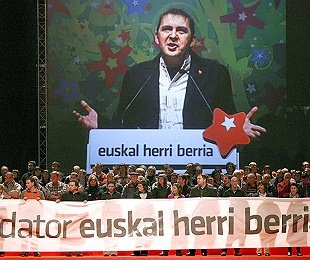

Batasuna leader says will not accept anything else than self determination
About 20,000 people attended a rally in the Bilbao Exhibition Center in the Basque town of Barakaldo convened by Basque nationalist leftist militants. The rally ended without incident and none of the speakers made any mention to Abertzale Sozialisten Batasuna (ASB)", a new party which, according to Spanish judge Baltasar Garzon, contains "several elements that indicate the political group is an apparent continuation of Batasuna,'' which was made illegal in 2003.
The court on Saturday allowed the rally to go ahead, provided no mention was made of the new party. Police said the rally had obeyed the court by not mentioning or displaying the new party's name.
Several people sang songs in favor of the Basque prisoners and their amnesty during the rally, held under the slogan "Badator Udaberri, badator Euskal Herri berria," (Spring is coming, a new Basque Country is coming).
Batasuna leader Arnaldo Otegi, speaking at the rally, said that the posibilitie of a democratic process to start is targeted by spanish goverment. Insisted that there is a way to resolve the conflict and that BATASUNA has put on the table the mthodology the main contents and its complete determination, giving all steps are in its hands. Pernando Barrena, another prominent leader of Batasuna, said they will not accept anything else that self-determination for the Basque Country.
More pictures and videos: www.euskalherriberria.org
NEW ATTACKS AGAINST THE PEACE PROC ESS

TWO ETA MENBERS ARRESTED IN FRANCE DECLARE THEY ARE MEMBERS OF THE NEGOTIATION TEAM AND THAT WERE WORKING ON THE PEACE PROCESS NEGOTIATION WITH SPANISH GOVERMENT
BOTH WERE ARRESTED LAST NIGHT IN PERIGOUD FRANCE.
JON IURREBASO AGED 51 AND KEPA MIRENA SUAREZ AGED 47 WERE ARRESTED DRIVING A CAR.
At least eight suspected ETA members arrested in Basque Country
03/28/2007
Spanish Interior minister Alfredo Perez Rubalcaba said more arrests are not ruled out. Five of the arrests were carried out in the Basque towns of Andoain, Donostia, Idiazabal, Oion and Uharte-Arakil.
Spanish Civil arrest one of the suspected ETA members.
The Spanish Interior minister, Alfredo Perez Rubalcaba, confirmed that eight people were arrested in a "wide" operation carried out by the Civil Guard that is still open and targeted ETA's infrastructure.
In a short appearance in Congress, Perez Rubalcaba apologised for the few details he could unveil, but insisted more arrests are not ruled out. "I can say nothing else," he said.
Thus, he didn't confirm if the operation targets the Donosti cell, as antiterrorist sources affirmed.As the association in defence of Basque prisoners (Askatasuna) confirmed, Joseba Lerin was arrested in Andoain, Juan Carlos Herrador in Donostia-San Sebastian, Endika Zinkunegi in Oion, Iñigo Orue in Idiazabal and Lorea Irigoienen in Uharte-Arakil.
30 March 2007
IV IRISH BASQUE ANNUAL NIGHT IN BELFAST
The Belfast Basque Committee is organising the IV IRISH-BASQUE NIGHT next Good Friday, 6th of April.
From 8.30pm at Conway Mill, Lower Falls Road, you will find Basque traditional musicians, Irish and Basque DJ's playing ska, reggae and Basque mixes, patxaran, t-shirts, video screenings...and many more surprises.
Previous editions have been a huge success. We ask everybody to come early to avoid disappointment as it always gets packed.
Tickets: £5 before 10pm / £8 after 10pm.Bring your own.
Pro independence left registers new political party at Interior Ministry.

Basque outlawed Batasuna's spokesman Arnaldo Otegi assured the Basque left-wing nationalist movement "fulfilled meticulously the Political Parties Law" when they registered a new political party, Abertzale Sozialisten Batasuna (Basque Socialist Patriots Union), as a new "step" to facilitate the "democratic process."
During a news conference, where no questions were admitted, Otegi said the new political party fulfills meticulously the conditions established by the Political Parties Law, even if he considered the law as "absolutely anti-democratic."
Otegi gave the news conference accompanied by several Batasuna leaders such as Pernando Barrena, Joseba Permach, and Maite Diaz de Heredia.
The Basque leftwing nationalist leader highlighted the new framework has been made to build a new "democratic situation" and not to challenge anyone. He asked the political forces to be "rigorous in their analysis" and to show "the same level of compromise" as the Basque leftwing nationalist movement is doing to reach peace.
Basque Autonomous government :
Basque Government criticized also the Political Parties Law, saying that it doesn't serve to face "future." She reminded the Basque leftwing nationalist movement decided, since its Anoeta proposal, to follow pacific and democratic paths.
Basque activists filed papers with the Interior Ministry to create the new party.
Batasuna's political activities were banned by the Spanish National Court judge Baltasar Garzon on August 26, 2002. Afterwards, the Supreme Court outlawed and dissolved the party as it considered it was part of the armed band ETA.
Leftwing nationalism announced it will hold an event at the Bilbao Exhibition Centre Saturday in which they will unveil their offer, as representatives of the group noted during the presentation of the event.
Interior Ministry statement
In a statement, the Interior Ministry said some of the people promoting the new party may have links to Batasuna or other separatist organizations banned by Spanish courts, and prompted investigations into those facts.
"The name of the proposed new party, Abertzale Sozialisten Batasuna, sounds very much like Batasuna", it added. And the by-laws of the new group contain nothing to suggest it is anything but a follow-up to Batasuna, the ministry said. Prosecutors will study the petition to form the new party.
Police arrested outlawed Batasuna leader Arnaldo Otegi
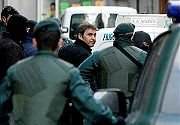
Spanish Police arrested the leader of banned Basque leftwing nationalist party Batasuna Wednesday to bring him to Madrid for a court hearing after he said he was stuck in the region because of a snowstorm.
Officers acting on a court order arrested Arnaldo Otegi at his home in the Basque town of Elgoibar, said a police official speaking on condition of anonymity because of rules that prevent her from giving her name put him in a militar plane and flied to MAdrid.
Officers were to bring Otegi to Madrid for a trial that was to have started earlier Wednesday. Arnaldo Otegi had been due to appear in a Madrid court earlier in the day to face charges of glorifying terrorism but had notified court officials that he could not make it on time due to snow blocking the road from the Basque Country.
The National Court had labeled Otegi's given reason for missing the start of the trial - a snowstorm that has snarled travel in the Basque Country - as unjustified. The Court said in a ruling that it had told the police to arrest him and deliver him for the hearing in Madrid at 6 pm (1700 GMT).
Otegi, who faces several court cases, was to stand trial this time on charges of praising terrorism, which is a crime in Spain. This case stems from remarks Otegi made at the funeral of 22-year-old Olaya Castresana, a suspected ETA member who was killed in 2001 when explosives she was preparing blew up. During the funeral, Otegi carried the coffin of Castresana and praised fallen ETA members as patriots.
After the trial walked free from Madrid's High Court on Wednesday after the state prosecutor dropped charges against him.
Subscribe to:
Posts (Atom)

 Posts
Posts

