30 March 2007

Iñaki de Juana Chaos ends hunger strike arriving to Basque Country as he said, after an heroic struggle and national and international solidarity and


Iñaki de Juana Chaos, an ETA prisoner on hunger strike for the past 114 days to protest his continuing imprisonment on a new, recent conviction for writing articles deemed as terrorist threats, decided Thursday to put an end to the hunger strike.
Juan Maria Olano, spokesman for Askatasuna, announced de Juana's decision some minutes before the Basque prisoner got the Donostia hospital.

"The main concern of Askatasuna .... now is that Inaki gets his health back and doesn't suffer any ill-effects from this dramatic hunger strike," said the spokesman for the Basque prisoners' association Askatasuna.

Spanish authorities moved de Juana from a Madrid hospital to one in the Basque region Thursday as a first step toward allowing him to serve the remainder of his sentence at home under custody.

28 February 2007

SOLIDARITY WEEKEND PROTESTS WITH INAKI IN IRELAND


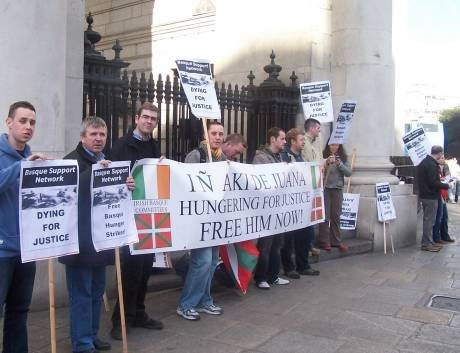
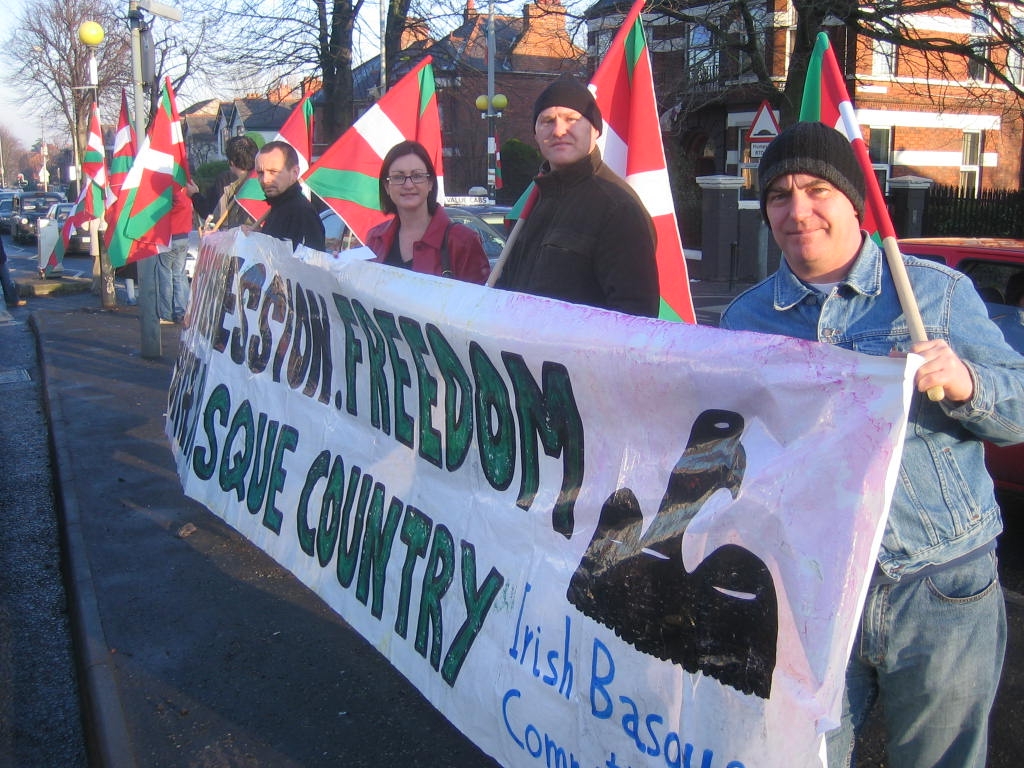
Protests were organized by the Irish Basque Committees in Belfast and Dublin on the 17th and 18th of February.

Dozens of people gathered in Dublin outside the GPO and in West Belfast's Falls Road to send their solidarity to the Basque hunger striker Inaki de Juana who is been already fasting for 113 days. Seven supporters fasted for 24 hours outside the Spanish embassy taking by surprise and obviously disturbing the Spanish ambassador. The public's response was hugely positive as dozens of signatures were collected during the weekend.

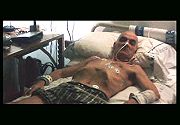
Recently he's been force fed once again and as he refused it actively he was tied to his bed. This torture is being held by the Spanish authorities while international concern is growing. Breaking news say that his situation is extremely bad.

22 YOUNG ACTIVISTS IMPRISONED


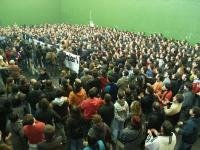
On the 19th of January the Spanish Supreme Court sentenced 22 members of the Basque pro-independence youth movement to 6 years in prison for their political activities. this decision was widely criticized by Basque political parties, trade unions and social movements. Yet another example of the "Spanish democracy". Most of them went on the run that very day (4 were arrested immediately) and turned up on the 4th of February at a political rally in "La Esperanza (The Hope)" Basque ball court in Bilbao.

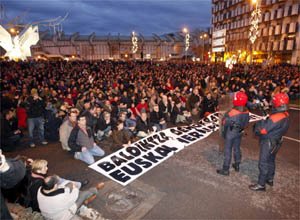
There they were supported by hundreds of people, among them the outlawed party Batasuna's leadership and dozens of journalists. A deep emotion filled the Basque ball courted. They waited for the autonomous police to be arrested while they held a banner where could be read: "Give way to independence. Basque youth onwards!"

Then dozens of heavily armed policemen showed up and one by one and among the cheers and tears of relatives, friends and pro-independence supporters.

It was a brave and audacious action which coped the newspapers frontlines and TV news next day even in both the Basque Country and Spain. Another terrible picture of the historical conflict between the Basque Country and the Spanish and French states.

After being arrested they were disappeared for more than a week as nobody had information of where they had been taken to. When the first news broke out the worst fears were confirmed as they suffer beatens at the Spanish police hands and were imprisoned in 20 different jails all around Spain at hundreds of miles from their country.

For more pictures and video: http://www.gaztesarea.net/info/berria.php?id=7380

8 February 2007

SPANISH CRUDELTY EXPOSED IN "THE TIMES" AS INAKI REACHES HIS 94TH DAY ON HUNGER STRIKE

Basque prisoner on hunger strike backs negotiation in 'The Times'
02/05/2007

Including a horrific photograph, the online edition of the British paper published the first interview with the prisoner, on hunger strike for over three months.

De Juana Chaos (Photo: The Times On Line)
The online version of the daily The Times published Monday an interview with Iñaki de Juana Chaos, Basque prisoner on hunger strike for 91 days.

"A convicted key member of ETA, the Basque separatist group, who is close to death after three months without eating, has called on the Spanish Government to resume talks to reach a peace deal," the first paragraph of the Times On Line article reads.

In his first interview since he started his second hunger strike (the first lasted 63 days), Iñaki de Juana affirmed he "strongly supports the peace process." "I am completely in agreement with the democratic process of dialogue and negotiation . . . to resolve the political conflict between the Basque region and the French and Spanish states," de Juana told The Times.

"After the event at Barajas . . . resolution of the conflict is more necessary than ever," he said in written answers to Times reporter in Madrid Thomas Catan.

For the Spanish Government, De Juana's protest "is a growing political nightmare," according to Times On Line. Highlighting that the prisoner could die in a few days or weeks, the reporter affirms that this could be the worst crisis Zapatero's Government undergoes since he took office in 2004.

After comparing De Juana's case with Bobby Sands', IRA member who died in 1981 as a consequence of a hunger strike, Times reflects on the dilemma of the Spanish Government: "If he dies, de Juana will become a martyr to the Basque independence movement. Some fear that ETA could use his death to justify a renewed bombing campaign ... But if the Government allows him to serve out a reduced sentence at home, as some judges advocate, it will provoke an outcry on the Right."

"I would not have abandoned the hunger strike in exchange for a reduced sentence. The only acceptable alternative is complete liberty and an end to the brutal attacks on freedom of expression that this legal process implies," he said.


FREE IÑAKI DE JUANA RIGHT NOW !!
MOBILIZE IN SOLIDARITY !!!

(SEE ATTACHED DOCUMENT)


Supreme Court to consider hunger striker's appeal on Feb. 12
02/05/2007

In turn, penitentiary institutions launched an investigation to know who took the picture of the Basque prisoner published in The times.


Basque prisoner on hunger strike Iñaki de Juana Chaos
The Spanish Supreme Court will consider the appeal lodged by the defence of the Basque prisoner on hunger strike Iñaki de Juana Chaos on February 12. He was sentenced to 12 years and 7 months in prison for terrorist threats in two opinion articles he published in the daily Gara in December 2004.

The 13 judges that make up the jury decided to give the appeal priority due to De Juana's health condition after 92 days on hunger strike.

In fact, the National Court recently studied the possibility to release him on parole, but eventually didn't do so.

Investigation for photo published in The Times

In turn, the penitentiary system launched an investigation to know how the interview with De Juana was made and who took his pictures.

Sources of penitentiary institutions explained that his partner, his lawyers and a group of Basque writers and musicians have only visited the prisoner.

The latest visit took place on January 31, when writer Laura Mintegi and other representatives of Basque culture visited De Juana.

The source affirmed that De Juana's photo, tied to his bed and fitted with a catheter to feed him, is "authentic" and "very recent."

It also added that no doctor authorised any media to interview the prisoner, who affirmed he wouldn't put an end to his hunger strike if it were not in exchange for his unconditional release.

25 January 2007

SPANISH COURT REFUSES TO RELEASE INAKI ON HIS 80TH DAY OF HUNGER STRIKE


The Basque prisoner will continue in custody and in hospital, although the Public Prosecutor had asked a reduction of the prison terms. The decision came with a vote, agreed by 12 votes to 4.

The Public Prosecutor asked on Febr. 24 the Spanish National Court to reduce the prison terms of ETA prisoner Iñaki de Juana Chaos, due to the deterioration of his health and the death risk after 79 days of hunger strike. The measure would include a permanent police surveillance.

Iñaki de Juana Chaos, on hunger strike for 79 days, is in the Madrid-based hospital Doce de Octubre, where he is being force-fed.

The National Court received recently a report written by two doctors that examined De Juana at the Madrid-based hospital Doce de Octubre. The report warns about the deterioration of his health and the death risk.

As it received the report, the National Court asked the sides implied in the case - the Public Prosecution's Office, the Association of Terrorism Victims (AVT) and the Defense of De Juana - to say if they deem it legitimate to take some measures for the health condition of the Basque prisoner Iñaki de Juana Chaos.

The Defense of De Juana asked to release the Basque prisoner on bail for humanitarian reaons, whereas the Association of Terrorism Victims (AVT) didn't want any change.

24 January 2007

THE MOBILIZATIONS THAT THE SPANISH GOVERNMENT DID NEED

Towards Independence and Socialism.
EUSKAL HERRIA-BASQUE COUNTRY. STEP BY STEP ASKAPENA's Informative Service, N. 161


The Spanish government had been carefully preparing a process to eradicate ETA: secret meetings, bilateral agreements, the non-fulfilment of the points previously agreed, non-stop repression of the negotiators in order to subdue them, trying to make the citizens believe that process is on the right path. The aim of this strategy was clearly to make impossible any answer from ETA and even to get that the solution of the process should be for the pro-independence faction at a high political cost.

In the same way, the Spanish government had already designed a campaign of social agitation which should be activated as soon as ETA would announce its intention of continuing with armed activity.

The government's initial calculations went wrong: ETA did not announce in advance its plan of attacking Barajas, against all odds. The government from Madrid which 24 hours before had declared that the peace process was in good shape found itself in a very weak and difficult situation. A weakness used from the very beginning by the right wing in order to attack the government, a government overwhelmed by the critical situation. The PSOE needed some sort of way out in order to accuse the Basque pro independence left wing of the attack against Barajas, trying at the same time to get the citizens backing to its policy during the nine months of cease of fire by ETA.

The fact that there were two victims, two dead immigrants as a result of the attack, was an excellent opportunity for the government to make the environment tense and to attract the immigrants towards the social net against the Basque armed organization.

The demonstration in Madrid

What had happened supposed a critical situation for the Spanish right as well. For nine months without any victims the Spanish right wing had asked the Spanish government once and again to stop any contacts with ETA. As soon as the attack on Barajas happened and two victims occur, the PSOE started the campaign that had previously designed.

Which one was the Spanish right wing's positioning? The PP's initial reaction consisted in attacking the PSOE, going from political confrontation to physical confrontation. In fact, some leaders of the Spanish PSOE party that were taking part in a demonstration in front of the Town Hall in Madrid had to escape and take refuge, since extreme right wing activists attacked them.

The second strategy by the PP consisted in avoiding by any ways that the PSOE should be the centre of attention in the demonstration organised by the trade unions close to the government and the Federation of Ecuadorian immigrants. In order to achieve this, the PP asked that the slogan of the demonstration should include ideas and concepts close to the ultra right wing. The UGT trade union -an organization within PSOE's structure- opposed itself fiercely to this approach, since it did not want to give the Spanish right any chance of becoming the centre of attention. In the end after a huge pressure UGT accepted the slogans proposed by the right wing.

But even if so, the Spanish right wing did not join the demonstration, furthermore, it asked that the demonstration should be called off. This attitude has been hardly criticised even by organizations close to the PP. This is the reason why, soon after it announced another exhibition of street ultra exhibition on the 3rd of March.

The demonstrations in Euskal Herria

The demonstration in Iruñea: Fissures and links.

The PP's attitude by rejecting participation left, an appendix of the PP within Nafarroa, in an uncomfortable situation; what could Unión del Pueblo Navarro do? UPN did not want to back PSOE, but it did not want either not to take part in a demonstration that presumably was going to be pretty successful. Unión del Pueblo Navarro made clear to PP that they were not very happy about the whole matter and in the end there were a few representatives of the Spanish right wing, the very few needed to figure.

The traditional Basque right wing had no problems in participating in the event along with the party they do often unconditionally support: the PSOE. Thanks to this support PSOE's repressive policy was undoubtedly strengthened. There were some other individuals along with the Ecuadorians, but there were anyway divisions.

Their representatives asked that "ETA's terrorism" should not be underlined. Even if so, during the gathering, some ultra-right movements appeared with banners making reference to "ETA's terrorism".

The demonstration in Bilbo: Thirst for confrontation

When the process was blocked, the president of the South-West Basque Country, Ibarretxe had made some sort of comments about the need of mobilising the citizens in order to reactivate the process. This idea was not compatible with the strategy designed by the PSOE, a strategy that until that moment had been closely followed by the Basque right wing, this is: "do not do anything and let the situation get blocked, since everything is under control".

After the attack against Barajas, the situation did change. Following the strategy from Madrid they had to mobilise society but, which slogan use for that aim? The PNV had no doubt about it: they would accuse ETA. The President of the PNV, being no so dependant on the PSOE, considered that they had to reassure the validity of peace and dialogue. Ibarretxe, the Basque Government President and the PNV chairman on the 5th of January discussed on the proposal and on the slogan for the demonstration.

The Basque Government President on that same day in the afternoon announced a demonstration under the maxim: "Peace and Dialogue" for the 13th of January. This proposal was badly accepted in his own party and much worse in the PSE. Even if so, on the 7th of January, the president of the pro Spain socialist party's maxim representative confirmed their presence in the demonstration.

But soon after, a new subject appeared. The Basque pro independence left wing, for months had been asking for peace and dialogue; it felt itself part of the society summoned for the demonstration, it had also made clear that they were prepared to lose all the prominence if doing so the peace process would get reinforced. But what would happen if the Basque left wing decided to go to the demonstration? The alarms went off!

The PSE in a not very democratic tone, made very clear that if Batasuna was also going, they would stay at home. The PNV, affected by some sort of hysterical and collective crisis, increased its demands so that "the bad boys and girls" should not go to Bilbo. The sectors close to Ibarretxe recommended keeping the slogan, but this strategy failed when Batasuna announced its participation. Ibarretxe, the Basque Government President, being under a huge pressure by the political parties and especially by its own party, decided to change the slogan "so that the violent ones could not go to a demonstration in favour of peace".

The PP rejected all the time any possibilities of going to Bilbo, the Basque pro independence left wing decided not to go since they had adulterated the initial project. The PSOE achieved to impose its scheme. In the PNV the party structure, very inclined towards any pacts with Madrid, was imposed. The most nationalist sector within the PNV that agreed with the initial slogan of the demonstration was defeated. The Basque bourgeoisie has once again bet on collaborationism supporting the Spanish governments' aggressive strategy.

Euskal Herria, January 2007. www.askapena.orginfo@askapena.org

22 January 2007

ETA-GOVERNMENT MEETING

Government admitted the importance of a Basque political agreement

01/18/2007 The Basque newspaper Gara unveiled that during the last meeting between the Spanish Government and ETA, both made clear that the peace talks were freezing and that the solution would be a political agreement.

The Basque armed group ETA and the Spanish Government talked during their last meeting in December about "a political agreement between the Basque parties" as a"key-solution" to unfreeze the peace talks, the Basquenewspaper Gara assured today. The Spanish Government "promised not to block the negotiations between Basque political parties so that they could reach an agreement", informed the newspaper. The newspaper assures that both manifested their desire to continue peace talks, but made clear that a political agreement between the Basque political parties would be fundamental.

ETA's proposal.

The Basque newspaper also assured that ETA presented to the Spanish Government a global proposal to develop the peace process when a political agreement would be reached to resolve the Basque conflict. This proposal and the Spanish Government's one should be analyzed by both, at least if the Spanish President didn't put an end to the dialogue. The meeting also treated the Basque prisoners issue. The Basque armed group asked, according to the newspaper, to respect the Basque prisoners' rights and to stop the use of exceptional measures. The group also asked the Government "to respect all the guarantees linked to the agreements that gave place to the cease-fire". They warned that "policial and judicial attacks" and the situation of Basque prisoner Iñaki de Juana Chaos (nowadays in 76th day on hunger strike) could "blow up the process".

SPANISH STATE ATTACKS BASQUE YOUTH ONCE AGAIN


Last Friday the Spanish Supreme Court launched his defenitive sentence against the Basque Youth Movement. The court brands it as "terrorist", asks for the arrest of 23 young people and charges them with 6 years on prison each. Four of them have been already arrested and put in jail.

Many Basque political parties, trade unions and social movements criticized the sentence and said it's purely political and attacks directly the process to resolve the conflict.

The protests rapidly spread all around the country and met brutal police response. Dozens have been badly injured and arrested.

On a press conference held at Gasteiz's main square by 100 youth under police surveillance they said that this attack won't stop their fight for independence and socialism.

19 January 2007

20TH OF JANUARY: BASQUE PROCESS INTERNATIONAL SUPPORT DAY


As a consequence of the difficulties that the Basque process is finding on its way an International Day of support is been called and in Ireland the Irish Basque Committees have organised some picket lines in Belfast (2pm outside Cultúrlann), Dublin (12pm at GPO) and Cork.

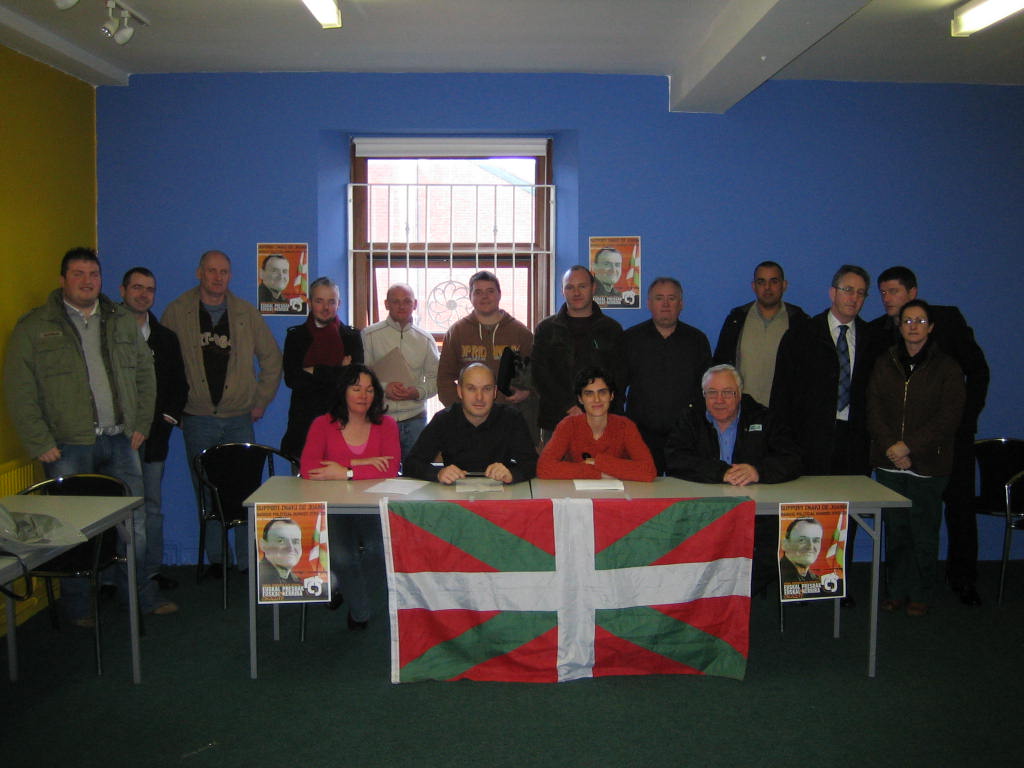
Last Wednesday a press conference was hold by the Belfast Basque Committee to launch their support campaign and along with them were the first ten Belfast signatories to the support petition, all of them well known people in the community, councillors, community workers, journalists...(you can read the petition and signatories below; press conference is in the picture above). Basque political prisoner Inaki de Juana who is on his 72nd day on hunger strike ws remembered as well.

Support dialogue and negotiation in the Basque Country.

The process for the resolution of the political conflict between the
Basque Country and the Spanish and French States is today much more
necessary than ever. The aim of this process must be to create strong
democratic grounds to overcome the present confrontation at two negotiating tables including all the political options existing inside the Basque society,

- At one table the political parties, social organisations and
trade-unions of the Basque Country seeking to achieve a common agreement about the key elements of the conflict. These include the Basque Country’s right to decide its future and the internal relationships among the Basque territories.

- At the other table, the Spanish and French states and E.T.A. need to negotiate and promote the demilitarization of the country and resolve the situation of the Basque political prisoners, exiles and all victims.


A resolution to this historical conflict is possible. For the negotiations to progress it is necessary to set basic democratic conditions enabling the participation of every sector in the struggle for a democratic solution to the rights of the Basque Country.


We, the signatories below, call on all sides involved in the conflict to fully commit themselves, despite any difficulties, in the talks process and political negotiations, accepting that Basque citizens will determine their own future.


We call on you also to show your support to the Basque people at this crucial time by coming along to the picket line that the Belfast Basque Committee is organising on Saturday 20th of January, International Day of support for the Basque process, at 2pm outside Cultúrlann.


First ten Belfast signatories to the “Basque process support campaign Petition”:


Michael Culbert

Tomaí O Conghaile

Fergus O'Hare

Paul Maskey

Chrissie Mhic Giolla Mhín

Jennifer McCann

Fra McCann

Pat Rice

Caoimhín Mac Giolla Mhín

Glen Phillips

16 January 2007

STEP BY STEP,ASKAPENA's Informative Service N. 161

(In www.askapena.org you can see more information about Iñaki De Juana's letter, the FRIENDSHIP GROUP's Open Letter to the European Union "TOWARDS THE PEACE PROCESS IN THE BASQUE COUNTRY", and about the demostration in Donostia with images of the violent police repression)

THE CRASH

For the last three months there have been crossed declarations between the Spanish government and Batasuna, being both completely different. From August the Basque left separatist party has been continuously declaring that the process was in crisis. On that very same month ETA itself had made clear that the agreements that had made possible the cease of fire were not being respected, and as a result of this situation the agreements were not being fulfilled.

In the same way ETA declared that it would answer any aggression made by the Spanish state. This speech did not coincide with the messages of the Spanish government and its partners, the Basque right wing. These last ones repeated once and again that the process was on the right path. It is not possible to consolidate a peace process when one of its parts respects the cease of fire, while the other one is doing just the opposite, by pursuing its interlocutors.

At the beginning of December, it was obvious that something very serious had happened: even the Basque right wing did accept that there was a crisis going on. The pro independence Basque left wing was more explicit: in a tone of great preoccupation, warned once and again that the process was failing, or had already failed. Being so close to a clash, new initiatives and voices started to ask loudly that the dialogue should be restablished.

The Government answered making use of its usual repressive ways. ETA answered with the aggression in Madrid to the multiple aggressions that an wide sector of the Basque society was suffering. On the 30th December, a high power bomb made explosion destroying the Terminus number 4 at the airport of Barajas in Madrid.

Even if the ETA activists informed once and again of the situation one hour before the explosion, in order to avoid unnecessary victims, two Ecuadorian immigrants died as a result of the explosion.The armed action by ETA originated a miscalculation on the plans by the Spanish government, since 24 hours before, Zapatero had explained that there had been some kind of contact with ETA, and he officially commented that things were going all right and that after one year everything should be much better. It was evident that the pretended optimism did not coincide with the previous confrontation that had happened at the back stage. The kind of the action has also put an end to the modus operandis by the armed band itself, since ETA has usually communicated the end of the cease of fire.

The first reactions.

First time political reactions were both confusing and contradictory. From Spain the right wingers were asking to stop any sort of contacts and to go back to the Anti-terrorist deal between the Spanish PSOE and PP. The government from Madrid changed its speech: at a first moment showed its intention of cancelling the contacts with ETA. The Spanish right wing understood this reaction as a defeat of the government, since it meant that there was a chance for the continuation of the negotiation process.

In the Basque Country the message was not so catastrophist. The Basque pro-independence left wing made very clear that the process was not broken and that it was more indispensable than never before. Some other open minded sectors within the Basque society were of the same opinion and asked to take action immediately in order to active the process.

Change of strategies.

The Spanish right wing reassured itself in its appeal for a "crusade" against the pro independence Basque left wing, in the meantime the Basque left wing asked to behave with responsibility, establishing new and solid bases in order to re-establish the dialogue.

The PSOE has once again been influenced by the pressure made by PP. As the time went on PSOE's initial strategy: it did start to declare that the process was not valid any longer. The Basque right wing, as it has been doing for these last months aligned itself with the belligerent speech of PSOE. A sector within the Basque right wing PNV presumed that there was nothing to be talked to Batasuna, and even less to ETA.The PSOE had designed a mass media campaign in order to spread a message that could not launch earlier, because ETA had not announced the end of the cease of fire. This strategy has meant that the PSOE has been overshadowed by the circumstances and the image of control of the situation. In the same way PSOE has suffered an electoral setback in relation to PP.

The bases of this mass media campaign are the following ones: the peace process has been definitely broken off and ETA is the only responsible for this situation. The time for dialogue has come to an end and repression and isolation have to be reactivated. The methods for this mass media campaign are the usual ones: the using of the deaths caused by the attack against Barajas in the media in order to call for people's demonstrations in order to condemn those ones making use of violence, to take advantage of the fact that both victims were immigrants in order to discredit the Basque left wing at a national and international level by making influence on the immigrant federations asking them to position themselves against the Basque left wing, to group all the political parties so that they should agree the aggression that they are planning, to demand that Batasuna and the Basque pro independence left wing should be illegal as long as they do not condemn violence.

They are ready for anything, but not to reflect calmly on the situation, trying to change its direction. The PSOE has clearly shown its intentions: as it has been impossible for it to seduce "the beast" now it wants to use violence against it, in this way PSOE wants to let clear to all the Basque citizens what kind of future they may expect if they do not follow the path for surrender.

It has been shown that PSOE has no political will in order to find a solution for the conflict, on the contrary, it has mere political interests, since its only aim is to win the next elections, even if they have to forget peace and democracy.

A crusade full of disagreements.

At the time of punishing the Basque left wing there are important disagreements between "the crusades". The government's intention is to reach an agreement between al the so called "democratic" parties, but PP does not accept any other consensus that is not within The Deal against Terrorism, according to its point of view any political party interested should sign on that deal.

On the other hand PSOE wants to reach a new agreement previously agreed by the rest of the parliamentary forces. Those political parties do happily agree to take part in the crusade. In the former days the demonstrations called to reject ETA have clearly shown this internal confrontation.

Between the political parties in Euskal Herria the internal division is pretty evident. Within the PNV, the sector under the control of President Ibarretxe has decided to organise a demonstration in support of "peace and dialogue". The Basque PP has declined the invitation to go to that demonstration. The Basque PSOE has criticised the way and the content of this call but it has confirmed its presence. The sector within the PNV closer to PSOE has finally but reluctantly accepted the proposal, since this sector would have preferred more explicit condemnations. The so called democratic parties want to change the motto of the demonstration including a repudiation of ETA, in order to avoid that Batasuna itself should assume and take part in the demonstration.

In this complicated context, on the 8th January Batasuna asked ETA to fulfil the cease of fire. ETA in a press release on 9th January accepts the invitation by Batasuna, criticises the attitude of PSOE and of part of PNV and makes clear that it does not give up its right to answer any aggressions against Euskal Herria.If this all had happened in Ireland it may have been said that the Sinn Fein had an influence on the armed organisation. Here, since we are pretty special, it has been understood just the opposite, this is that Batasuna is under the control of ETA.

Euskal Herria, 10th January 2007. info@askapena.org // www.askapena.org

Spaniards Want Government to Negotiate with ETA

January 15, 2007


(Angus Reid Global Monitor) - Many adults in Spain believe their administration should seek new talks with the country's most notorious armed group, according to a poll by Instituto Opina released by Cadena Ser. 55.2 per cent of respondents think the government should keep trying to negotiate the end of terrorism.

On Mar. 22, 2006, Basque Motherland and Liberty (ETA) announced a "permanent ceasefire" and urged the "authorities in Spain and France" to "approach the issue in a positive manner, and leave repression aside.". 66.2 per cent of respondents think the government was right to initiate a peace process with ETA.

On Dec. 30, a car bomb exploded inside Madrid's Barajas International Airport. While ETA had telephoned authorities three times to report the attack, two people who were not evacuated from the T4 terminal lost their lives. On Jan. 11, Spanish president José Luis Rodríguez Zapatero confirmed that his government's talks with ETA are over. 64.2 per cent of respondents are hopeful about the eventual return of the peace process.

Also on Jan. 11, Zapatero discussed the situation at a meeting with regional politicians, saying, "Given that just a few days ago we had a tragic accident, a tragic terrorist attack at Barajas, I wanted to propose that we show our energetic condemnation and also our profound solidarity to the victims."

Spain's Association of Terrorism Victims (AVT) issued a statement, expressing dismay at Zapatero's use of the word "accident", adding, "The president has adopted ETA's discourse, and although he tries to mislead Spanish society, his subconscious has betrayed him in a most revealing fashion."

Polling Data

Despite the attack, do you think the government should keep trying to negotiate the end of terrorism?


Yes
55.2%

No
38.3%


Despite the attack, do you think the government was right to initiate a peace process with Basque Motherland and Liberty (ETA)?


Yes
66.2%

No
22.9%


Are you hopeful on the eventual return of the peace process?


Yes
64.2%

No
26.1%

11 January 2007

Batasuna spokeperson says no other choice but to resume peace process

Batasuna leader said he is totally convinced this time next year we will be better than we are today if we all face up to our responsibilities.


Spokeperson of Batasuna Arnaldo Otegi said that ETA's statement was "sufficient" for resuming a peace process, after a car bomb last December destroyed a five-story parking garage at Madrid airport.

ETA claimed responsibility for the bombing Tuesday, but insisted the truce it called in March and described as permanent is still in force. It was the first deadly attack by ETA since May 2003.

In Donostia-San Sebastian on Wednesday, Otegi said that ETA's statement was a "constructive answer" by ETA after Batasuna called on the armed group to return to a nine-month ceasefire on Monday. This makes him be totally convinced this time next year "we will be better" than we are today if "we all face up to our responsibilities," he added.

Otegi also pointed out that the commitments ETA made declaring the permanent ceasefire must "give rise to" work in the reconstruction of the conditions that can start again the process because "there is no other choice."


Spanish Deputy PM sees no way for Batasuna to run for elections
01/10/2007

According to Fernandez de la Vega, ETA's statement ratified the rupture of the truce. Furthermore, she assured the Antiterrorist Pact is a "small paper" containing "no valid" elements "because time has passed."
Spanish Deputy Prime Minister, Maria Teresa Fernandez de la Vega, assured today that Batasuna is "certainly" an illegal party, and, thus, she sees no way for the party to run for elections.

During an informative breakfast with journalists dealing with ETA's latest statement, De la Vega assured that it "ratified that ETA has broken the truce clearly" and that the armed band itself "admitted the Spanish Constitution and the law are the limits imposed by the Government."

Likewise, she referred to the Pact for Liberties and Against Terrorism and noted that there are "very valid" elements in the pact, but some others "are not, because time has passed," De la Vega said, and added that the agreement is a "small paper." "It's a series of issues that are there, that worked very well, but today is not like the year 2000 (when it was defined)," she affirmed.

POLICE OPERATION
Two arrested in Lapurdi

01/09/2007

The detainees are Asier Larrinaga and Garikoitz Etxebarria Goikoetxea. Larrinaga is linked to an arms cache discovered in Amorebieta and to explosives found last week in the same area, the Ministry said in a statement.


Site where alleged ETA members where arrested in Azkaine

Two suspected members of the Basque armed group ETA were arrested Tuesday in the Basque province of Lapurdi (Labourd), in North basque Country under french rule. The detainees were identified as Asier Larrinaga and Garikoitz Etxebarria Goikoetxea. Police links Larrinaga to an arms cache discovered Dec. 23 in the Basque town of Amorebieta-Etxano and to explosives found last week in the same area, in the Valley of Atxondo, the Ministry said in a statement.

The arrests were made near the town of Azkaine (Ascain). "The arrests were made early this morning near Ascain and police seized at least one pistol," the Interior Ministry reported.

10 January 2007

ETA AFFIRMS 24-MARCH CEASE-FIRE STILL HOLDS

In the statement the Basque daily Gara received, ETA claimed responsibility for the Madrid airport attack, but added that its March declaration of a permanent ceasefire still stood.

Basque armed group ETA insisted yesterday that a cease-fire it declared on March still stands, even as it claimed responsibility for a Dec. 30 armed attack in Madrid Airport.

ETA made its assertion in a statementsent to the pro-independence newspaper Gara. ETA said it did not mean to cause casualties in the attack, accusing the government of failing to evacuate the parking garage targeted at Madrid's airport despite three warning calls pointing out exactly where the car bomb was parked. The airport was largely evacuated, but both victims were sleeping in parked cars.

ETA blamed the Spanish Government and the governing Socialist Party for "placing obstacles endlessly in the democratic process," Gara said in a summary of what it called a long Basque-language statement.

Hours before ETA's statement, the government announced the arrest of two suspected ETA members in the North of the Basque Country linked to arms caches found in late December and last week in the Bizkaia. They were the first arrests since the Madrid car bombing.

Peace process, in danger.

ETA and other parties had been warning in recent months that continued arrests and trials of suspected ETA members were endangering the peace process, which was launched with its announcement March 22 of a "permanent" cease-fire. It had been demanding, and the government refusing, the transfer of ETA prisoners from jails around Spain to prisons in the Basque region. Spain's Government has responded to the bombing by scrapping plans for negotiations with ETA and declaring the once-promising peace process terminated.

Home Minister Alfredo Perez Rubalcaba said he had not immediately read ETA's statement, but his initial impression was that "ETA has only one path left to take, which is to end the violence."

Right to "respond".

In its statement, ETA reiterated a claim that the government had made,and was not keeping, commitments as part of the process that began with the truce. The group wants to promote the process, but reserves the right to "respond" if government aggression against the pro-independence movement continues, Gara reported. ETA insisted progress in the process must come from a "political agreement" that includes "the minimum democratic rights owed to the Basque Country,'' an allusion to Basques long-standing demands to be able to decide between their future.

Demand to halt fruitless "police formulas and policies."

It called on the government to halt "police formulas and failed policies that lead nowhere," said Gara.

THOUSANDS OF PEOPLE ASK FOR DEMOCRACY


Thousands of people gathered outside the Donostia-San Sebastian's Cycle-Track last Saturday as the Basque autonomous police blocked the entrance to the political event organised by the pro-amnesty movement.

Due to this prohibition, one more among the one hundred banned demonstrations on 2006, the pro-independence supporters started a rally with a banner at the front with the slogan "Democratic conditions for the Basque Country".

At the end of it they sat on the ground and sang the "Basque soldier"'s song. It was then when the police charged against the crowd. Some people were arrested and some others injured and brought to the hospital.

Juan Mari Olano, spokesperson for the pro-amnesty movement, said at the beginning of the rally that they wanted to launch a proposal for the democratic resolution of the conflict. He added that it is impossible to sort the conflict while one of the parts is hands tied and that repression can't be the answer. He praised the thousands of people who gathered for their brave stand for self-determination right.

More than 50 internationalists came from all around the world including a member of the Belfast Basque Committee to support the Basque process. When they where on their way to the rally the Spanish Guardia Civil (militar police) stopped them and kept them for an hour. It was then when they arrested Sebastien Dadouret, journalist from Paris and member of the international group. After three days on their hands where he was tortured he was put in jail and charged with "helping an armed band". Askapena, the internationalist organitation denounced this arrest as an attempt to criminalise the solidarity with the Basque Country.

A Inaki de Juana's letter was to be read at the event but as it was banned it's been made public during the week. The political prisoners who is been already for 65 days on hunger strike sent his greetings and strength and made clear his commitment to continue on hunger strike to defend the Basque political prisoners' rights. He wrote amnesty is an essential concept to the resolution of the conflict as the prisoners are a consequence of it.

4 January 2007

SOLIDARITY PROTESTS IN IRELAND WITH HUNGER STRIKER INAKI


Last Saturday 23rd two protests took place in Ireland to highlight the Basque political prisoner Inaki De Juana's situation on his 47th day on hunger strike. The protests were organised by the Irish Basque Committees branches in Cork and Belfast (see picture). You can read here the text of one of the couple of thousands of leaflets dropped at the protests:

On August 7, Basque Political Prisoner Iñaki de Juana began a hunger
strike to demand his right to be released. Iñaki de Juana should have been released on October 25, 2004, after serving his sentence in full and having spent 18 years in jail. However, the Spanish Special Court issued a decision dated October 22, attempting to contest the remission Iñaki was entitled to and to prevent his release .

In view of the impossibility to maintain this line of argument, the Court decreed his remand in custody for an alleged crime of membership of an armed group and terrorist threats.

The basis for the accusations were two opinion articles the prisoners sent to the daily Gara . It is impossible to find any rational basis in the articles to sustain such charges. Precisely, on June 14, 2006 the charges were dropped.

At that point a media campaign was unleashed against that decision.
The Minister for Justice stated “we shall build new charges so that they (Basque Political Prisoners) are not released!” The State General Prosecutor said "we shall continue to oppose his release insofar as it is legally possible" and appealed the decision.

Therefore there was a new request for a 96 year prison sentence.

His situation led him to go on a hunger strike for 63 days. He just went off when was told that he’d requested for 2 years. On October 26, the trial against him took place in the Spanish Special Court in Madrid.

Days later, the court decision was published; it sentenced Iñaki de Juana to 12 years and 7 months in prison. Therefore, it can be seen how in Spain, as in Guantanamo, there are situations which take us back to the time of the inquisition and which show what the criminal law for the enemy is, tailor-made, and based on hatred and revenge.

In this situation of absolute injustice, on November 7 Iñaki de Juana
began another hunger strike, which is adding to the 63 day strike he had ended only a few weeks earlier, after having lost 24 kilos (3st, 5lb).


This is a call to all groups and people in solidarity, to express their protest to Spanish consulates and embassies and to send their messages to the addresses of the following people, directly responsible for Iñaki de Juana's and the rest of 700 Basque Political Prisoners’ situation.

Help save Iñaki's life!

(Spanish Embassador in Ireland)
D. José de Carvajal Salido
Spanish Embassy in Ireland
17A, Merlyn Park, Ballsbridge Dublin
Tel: 269 16 40
Fax: 269 18 54
Email: embespie@mail.mae.es.

(Spanish Prime Minister)
José Luís Rodríguez Zapatero
Presidente del Gobierno Español
Palacio de la Moncloa,
Avda. Puerta de Hierro, s/n.
28071 Madrid
España
jlrzapatero@presidencia.gob.es
Fax: 0034 913900217

(Spanish Special Court's President)
Carlos Divar Blanco
Presidente Audiencia Nacional
C/ García Gutiérrez, 1
28004 Madrid
España
Fax: 0034 913973381

(Spanish Prisons' Director)
Mercedes Gallizo Llamas
Directora General de Instituciones Penitenciarias
C/ Alcalá, 38-40
28014. Madrid
España
Fax: 91 335 40 52

CALLS TO SUPPORT THE BASQUE PROCESS

BATASUNA ON MADRID ATTACK

The leader of the banned political party Batasuna, Arnaldo Otegi, has assured that the attack on saturday in the Madrilenian airport of Barajas does not imply the rupture of the peace process. In fact, he has appealed to "serenity and responsibility". "The process is not broken", has insisted calmly, in fact, now it is more necessary that never to maintain it alife "because is what the Basque and Spanish majorities want" it is time to reinforce and estabilise it.

Just after that, Arnaldo Otegi remenbered that in the last few moths Batasuna has many times denounced that the process to overcome the conflict had structural problems. Also mentioned that in the past nine months no party's board has been formed, that there is no agreement and also, has not neared the prisoners and Iñaki de Juana Chaos, in hunger strike, is on the verge of dying "tied to the bed of a hospital". Has criticized that representatives of the socialist Executive "has been boasted to have done less than the others" in previous truces. All of these, Batasuna believes, clearly shows how fragil the process really was. Otegi has blame the spanish government of letting the cease fire reach to an end underlining that a process can not be built in such a situation.

Never the less the situation is not "Broken" believes the left pro-independence party, "the process is necessary and we must go on" underlining its compromise to go to the end.

Strong bases are needed, "Sadly, if there was anything agreed it has not been fulfilled and if there was none nothing has been build" said Otegi. "Todays attack must not bring us back to the situation before the 24th March" day of the cease-fire was called.

To re-start the process and go on with the talks some "basic conditions" must be ensured. All the differents sensbilities must take part in a process to build a new framework in the absence of violence based on respect. "All the parties involbed must take part on this compromise towards resolution, Batasuna will forward new ideas to make that dialogue posible"

In his intervention, the spokesman of Batasuna has expressed his "solidarity with the wounded" and their hope "so that it appears the body of the missing person"


ATTACK

Car bomb explodes at Madrid's Barajas airport
12/30/2006

Two police, who were looking for the suspect vehicle, and two more people were slightly injured in the blast.

A car bomb exploded in a parking lot at Madrid's Barajas airport on Saturday after an anonymous telephone warning, Spanish police said.

The blast came about 9:30 a.m. (0830GMT) at the airport's new Terminal Four, said Javier Ayuso, a spokesman for the emergency rescue services of the Madrid city government. A warning had been telephoned to motorway rescue services DYA in the Basque region of Gipuzkoa.

Barajas Airport's Terminal Four was evacuated after the warning, state radio reported. Two police officers who were looking for the suspect vehicle, a taxi driver and a fourth person were slightly injured and taken to hospital.

A huge column of thick, gray smoke rose from the blast site more than an hour after the explosion and the building housing the parking lot appeared to be on fire. The airport is not operative, said Iberia, the Spanish flagship carrier that runs most flights out of this terminal.

Three phone calls

According to the Basque radio station Euskadi Irratia the anonymous caller phoned three times. He first called the DYA at about 8:00 in the morning and warned of a bomb at Madrid's Barajas airport's new Terminal Four which was due to explode at 9:00.

Thirty minutes later, there was a second phone call, this time to the emergency coordination centre SOS Deiak, asking to take the warning seriously and claiming to speak in the name of the armed Basque group ETA. There was a third phone call to the Madrid firefighters.


REACTION TO THE ATTACK

Spanish Govt. suspends "all initiatives for dialogue with ETA"
12/30/2006

Spanish President José Luis Rodriguez Zapatero said "today's attack is incompatible with a permanent cease-fire.''

Spanish Prime Minister Jose Luis Rodriguez Zapatero on Saturday suspended dialogue with the armed Basque group ETA after a bomb wrecked a car park at Madrid's international airport being the first attack after nine months of unilateral ceasefire.

"As the conditions that we laid down have not come about, I have ordered the suspension of all initiatives to develop a dialogue," said Zapatero at Moncloa Palace in Madrid's outskirts.

Zapatero considers "that today's attack is incompatible with a permanent cease-fire'' and as a consequence he has decided to suspend all initiatives for dialogue with ETA."

NEW YEAR'S EVE'S MESSAGE

"I won't consider peace process or dialogue broken"- Basque PM
12/31/2006

The Basque Autonomus Region's (Three of the seven Basque provinces) president said after the attack in Madrid's airport "the right of the Basques to decide their future is not neither in the hands of ETA, nor of the Spanish Govt., but in the hands of the Basques themselves".

Basque premier Juan José Ibarretxe said Sunday the armed Basque group "ETA has spoiled us the New Year's Eve but it has not taken away our hope".

In his traditional New Year's Eve message, talking about the situation in the Basque Country after a bomb wrecked a car park at Madrid's international airport , Ibarretxe said neither the Basque Government nor the Basque President "will consider the peace process or the political dialogue broken." "We can not let our hope crumble," he added.

Ibarretxe expressed sympathy for the two people still missing and those hurt in the blast after the car bomb blast in Madrid's airport.

"Our aim and our responsibility is to work in order to achieve peace, as well as to reach political agreements to decide our future, among everybody, here, in the Basque Country", Ibarretxe said.

Ibarretxe added that "(we) will not move forward as we keep mistaking ETA's violence with the solution of a political conflict. It is necessary not to mistake or to make the end of ETA's violence conditional on our right to decide our own future or, on the contrary, to make our democratic right to decide conditional on the end of ETA's violence".

On this matter, the Basque president remarked "the right of the Basques to decide their future is not neither in the hands of ETA, nor of the Spanish Govt., but in the hands of the Basques themselves".


BOMB BLAST IN MADRID

Basque Socialists suspend dialogue with Batasuna
01/02/2007

Rodolfo Ares has underlined that "dialogue is incompatible with violence and it is impossible to continue our commitment to dialoguing with those who carry out violent attacks and show no will to change their attitude".

Rodolfo Ares
Secretary of Organisation of the Basque Socialist branch PSE-EE Rodolfo Ares announced on Monday that his party had suspended "its talks with the leftist Nationalists".

Ares stated that " dialogue is incompatible with violence and it is impossible to continue our commitment to dialoguing with those who carry out or excuse violent attacks and show no will to change their attitude".

At a press conference held in Bilbao, the Socialist leader assured that he considered "a mistake by the Basque government and the Basque Premier to continue dialogue" with banned Batasuna, "as if nothing has happened".

12 December 2006

BASQUE SOLIDARITY PROTESTS IN DUBLIN


A Basque solidarity rally was hold in Dublin last Sunday.It lasted about 1.5 hours, near Stephen's Green end of Grafton St, Sunday 10th. It started with Txalaparta performance, followed by Zanpantzar performance, 10 men in traditional costume, with another as the bear, led by a woman carrying the Basque flag. Supporters gathered around (40-50 people) and cheered them on. Supporters displayed a banner with the slogan "SELF-DETERMINATION FOR THE BASQUE COUNTRY". As well as Basque and Irish supporters, there were also Catalans in attendance, who displayed their own banner: "CATALONIA IS NOT SPAIN"Many passers-by, both Irish and non-Irish (tourists and foreign workers), stopped to listen and watch, or to ask questions of supporters.

Over 800 leaflets were given out explaining the cultural background to the performances and the historical and political background to the Basque struggle for self-determination.

Many signatures were collected on petitions in favour of the involvement of Spanish and French States in a process of talks and negotiations accepting the rights of all the Basques to decide their own future as the key to the resolution of the conflict.During the afternoon, some songs were sung and slogans shouted, in between performances of Zanpantzar and Txalaparta.

At the end of the afternoon, Germà Martin, speaking in Basque and in Catalan, thanked the performers and the supporters for their attendance, asked for continued support for the Dublin Basque Committee. He was followed by Diarmuid Breatnach, speaking in Irish and then in English, who said the same things and concluded with "Gora Euskadi" and "Visca Catalunya". Some supporters and Txalaparta performers then went into the Temple Bar area and put on another performance there.

Many of the supporters and performers met later that evening in a bar and enjoyed an evening of music and comradeship. The Dublin Irish Basque Committee is in the process of reorganising itself and this performance was an important first step.

SOLUTION IS CALLED SELF DETERMINATION


As we already mentioned in previous bulletins he attempt of starting a
peace process has surprisesely provoked a huge convulsion in Euskal
Herria. It could not be in another way, since there are very opposed
interests. The only objective of both the Spanish government and its
Basque very loyal allied, the right wing political party PNV, consists
in eradicating ETA. They have no intention of going to the roots of
the conflict in order to reach an everlasting solution. The Basque
left wing pro independence party on the other hand, does not accept
any false solutions to the conflict, since if the conflict is not
properly solved it will last for at least another forty years or even
longer.

The PSOE and PNV want to achieve their goal by coercing the Basque
left wing pro independence party in many different ways, but in the
end they try very hard to weaken it so that only their conditions are
accepted without any kind of political normalisation. They want just
to defeat the Basque left wing pro independence party by using police,
judicial, mass media and economic repression. Even if so, from the
Basque left wing the answer has been very different, it has mobilised
its supporters in a positive way and always having the future in mind.
The strategy has been to answer repression by increasing nation and
democracy consciousness, asking for self determination.

The grounds of this initiative

On September 16th an ample and qualified group of representatives of
the left wing pro independence party appeared to announce the
beginning of a campaign the aim of which is to gain the right of self
determination. An initiative to add forces which was held in many
places; the slogan of this campaign was: "We have to back a democratic
resolution of the conflict because we need self determination". This
vindication is to be made everywhere in Euskal Herria.

· Objectives: the campaign itself has two objectives: "To promote
strongly this historic opportunity in order to find a solution and to
face false expectatives."

· Punctual reasons to back the Peace Process: "The process is
undergoing very hard times, it nowadays suffer of a blockade. Despite
the fact that it should be the exercising of a democratic right, it is
nowadays just another sort of process the aim of which is to weaken
and condition the left wing pro independence party. The Basque right
wing party PNV is the accomplice of the Spanish PSOE in this task".

· Positive elements: "The already started democratic process has been
backed by most of the Basque population. The political debate
originated under these circumstances has reached every corner within
the Basque Country. Save for very rare exceptions, the different
political, social and unions' agents have let very clear the relevance
of political negotiation. The matters to be discussed, this is,
territoriality and self determination are very present in the debate.
Despite the blockade there is an almost universal will to continue
advancing".


Development of the campaign for self determination.

· Backing of relevant characters: referential people in the struggle
of our nation in favour of freedom consider that the political
situation that we are undergoing is crucial and that the strategy by
the left wing pro independence party is the most adequate answer in
order to solve the situation in a positive way. There was a first
appearance on the 20th of September in Donosti, and another way on the
27th in Bilbo. In both cases the message is pretty much the same; the
characters that appeared made clear the importance of the campaign
showing their solidarity at the same time.

· People's backing of the process: on the 30th of September five
simultaneous demonstrations were held; they all had the same
vindication: "Euskal Herria, self determination": In Baiona hundreds
of demonstrators took the streets. In Iruñea 1.500 people took part in
the demonstration. It is worth mentioning the presence of ex prisoners
carrying a banner. In this demonstration as well as in the rest of
them there is the same message going on: "The right to decide is
essential. Where is freedom if it is not recognised? If the persons
have rights why not the nations?" The demonstration which happened in
Bilbo was the most populous one with almost 8.000 people. It has a
clear internationalist connotation. The slogans in favour of
independence and socialism get mixed with other mottoes in favour of
Lebanon and Palestine. Many participants wearing Palestine shawls ask
for the active boycott against sionism. In Donostia 3.000 people ask
for independence and democracy for Euskal Herria. In Gasteiz 1.500
participants march with the photographs of the Basque political
prisoners; they also carried banners in which appeared the different
nations fighting for their freedom and against imperialism.

· To fight fascism: self determination. On the 12th of September Spain
celebrated the day of the Spanish patriotism. This day, as it can be
easily understood is very critically seen from Euskal Herria. This
year Iruñea has had a special political relevance, since the Spanish
right wing has chosen this territory to transform it into its
stronghold and in this way reject every Basque nationalist
expectations. On the one hand, the Spanish military police: "guardia
civil" organised a parade in which military, political and religious
authorities (As the Pope in Rome made some weeks ago, the archbishop
of Navarre wore the Spanish military police cap during the
celebrations); on the other hand, the pro nazi Spanish movement
organised a street demonstration protected by the Spanish police. In
the evening almost 3.000 citizens from Navarra, facing all these
provocations, went to the street to ask for their right to decide.

The Big Walk. The social and political agenda for these months is full
of events to ask for our right to decide our own future. It would be a
hard task just to mention them all. The most notorious one took place
in Bilbo on the 11th of November. 26.000 people of all ages marched in
the streets with a banner with the slogan of the campaign. At the end
of the celebration Arnaldo Otegi, one of the usual representatives of
the left wing pro independence party: Batasuna, transmitted these very
same messages to all the expectant citizens: "Night is even darker
just before daylight; things go wrong but there is a chance somewhere
there? They should stop using ETA and street fighting as a mere
excuse; the responsibility to make the peace process advance is mostly
in the hands of the political parties of Euskal Herria and, it is also
in the hands of the Spanish government in order to stop all the
aggressions against the Basque left wing. It is a paradox that the
official pacifists are afraid of peace and political debate, and yet
we "the aggressive and violent ones" are the ones who are claiming for
it. They know that their political project is weak and we know that we
will achieve independence as long as we are let free to make our own
choice. Our aim has a huge dimension since we want to solve an armed
conflict that has been going on for centuries; this is why the Basque
left wing is taking the right decissions; but are we asking for the
same compromise to the rest of the agents; the left wing pro
independence party will never sign a document which has no guarantees
for a democratic context in this country and for the definitive
solution of the conflict"


Euskal Herria, 1st December 2006
info@askapena.org // www.askapena.org

THE SPANISH (UN)JUSTICE. INAKI DE JUANA ON 36TH DAY OF NEW HUNGER STRIKE.


>
>The Basque political prisoner Iñaki de Juana, after completely serving
>his sentence (almost 20 years imprisoned), should be out of jail from
>the year 2003. But in the Spanish State, the times of sentences are
>elastic and malleable. As the former Justice Secretary said on 2005,
>it was necessary to find any way for keeping Inaki in jail although he
>had already served his sentence. With this stupid pretension a 96
>years sentence was requested based on two opinion articles. The
>prisoner started a hunger strike that lasted 2 months. He was fed
>against his will under an order of the Spanish National Court.
>
>Inaki gave up his stance when he knew that the prosecutor reduced his
>petition from 96 years to 6. But this is not what happened. The court
>took place and the prosecutor asked for 13 years. One day before being
>the condemnatory judgment to 12 years and 6 months of jail for two
>opinion articles known (November the 7th), Inaki again declared
>himself in hunger strike reiterating his decision for driving his
>protest to the extreme. He requested to the Prison Governor to remain
>in total isolation, renouncing to any contact with his family. Prison
>Institutions, trying to harden the situation, have requested
>permission to the Spanish National Court to place Inaki in a sharing
>cell with other prisoner.
>
>In this bulletin we want to reproduce pieces of an interesting opinion
>article published in Gara newspaper on 30 October by Manuel F. Trillo,
>Law Professor.
>
>Freedom of speech, amputated freedom
>
>I have listened the statement of an accused, judged because of writing
>two articles. In them he mentions some people who are prison officers.
>The prisoner complains about the treatment received from them?
>
>Is not understandable that a prisoner complains about the prison and
>the jailers? Does not the slave complain about how cruel is his
>master? And the master because he has to treat with a slave? All of us
>complain; some ones can to say it in low voice but other ones can
>shout it. Do not the prison officers complain about how hard is their
>job? But, the person who writes two articles naming his jailers is
>being judged just because of mentioning them. If I had the idea to
>publish that my boss, my bigwig is a rotten, would be myself object of
>criminal proceedings? I have listened very quietly Inaki's statement
>during the hearing. The tone was somebody's who is tired of so much
>grudge, who knows himself symbol of a personal and collective combat
>which took him to prison 20 years ago. The arguments were so
>convincing that they were un-attackable.
>
>It is really difficult to me to accept the double measuring stick: On
>October 27th, during the oral hearing, the extreme right wing
>demonstrated in front of the Spanish National Court cutting the
>traffic during more than an hour and they were not suppressed. Would
>have the police had the same consideration if Batasuna´s supporters
>were the people cutting Genova Street? From here I ask to the
>Government Vice President: Why you allowed the extreme right to cut my
>right to the free circulation? I only have sympathy for the Law.
>Because of that I understand that anyone who makes an offence pays
>with jail the crime. But I can not support that they make fun of us
>using and abusing the Law depending of the ideological colour of the
>people who violated it.
>
>There is something that has taken my attention completely because it
>has nothing to do with what was being judging and it is that the
>prosecutor, on certain moment, asks to the defendant: If you leave the
>prison, what would you do? But, prosecutor, how low can you get? You
>know that this is not the cause of the trial because here it is
>another question in the air: the publication of two articles. And you
>ask to the accused about something relating his future. Burgos
>prosecutor, tell me one thing: Do you know what will happen to you in
>three days time? Prosecutor, I am going a bit farther, do you usually
>ask the same question to the rapists, women batterers, corrupts, drug
>traffickers, ??
>
>I have also seen that they have allowed get inside the hearing room
>two individuals who uttered threats. The fact that these characters
>get access as a public but friends of the defendant were not allow to
>get in seems a nonsense to me. I am absolutely perplexed when I listen
>to the magistrate saying to take their identities and that they will
>be accused of disorders; come on please, both of them have uttered
>death threats, "look at me because this is the last thing you are
>going to see in your life". The threat was said in a tribunal and it
>was not a private offence; it is evident that the Judge and the
>prosecutor should have acted in consequence. Make your job. If the
>accused had pronounced this phrase in his articles, which one would
>have been the magistrate's and prosecutor's deduction?
>
>In the Spanish National Court the Freedom of Speech has been judged.
>The judicial operators know it; those who try to confuse the
>population know it. The discussion in this trial is the freedom to say
>that somebody is a rogue. This is the reason way this trial is not
>trivial. Fundamental rights are at stake. I can not imagine another
>sentence but absolution because two articles are not guns and words
>are not bullets. I hope the judge knows to ensure that the law is
>upheld. Otherwise, it would be a huge indignity.
>
>By way of conclusion
>
>While we are writing this bulletin, Iñaki has already lost six
>kilograms and is health, already deteriorate because of the previous
>two months lasting hunger strike, is getting worst by moments. His
>fellows in Aranjuez Prison are doing a rotary fasting in solidarity
>with the prisoner. The anti-repressive organism Askatasuna (freedom),
>has talked to the Government of Spain. Reminds it that "it is
>maintaining the policy to kill the prisoners and destroy the
>collective of Basque Political Prisoners following the guidelines of
>the anti-terrorist pact signed with the Popular Party? These are the
>principal obstacles to reach a definitive solution". And, referring to
>the Basque society: "It is the time to bring together strengths
>against every aggression and interferences".
>
>Basque Country, November 22th, 2006
>info@askapena.org // www.askapena.org
>

2 November 2006

EUROPEAN PARLIAMENT IN FAVOUR OF BASQUE PROCESS


The analyses of some other processes on their way to be resolved have something in common and this is the need of international support so the process can go on. Euskal Herria obviously is not an exception. For so many years, may be for too long, there has been not even a remote possibility for a negotiated resolution of the conflict. At an international level only the cruelty of the conflict was exposed. The Basque pro independence left-wing has non stop trying to make known that it has always been a political conflict, and as such, that it needed a political solution.

But this political sector had very restrained means to socialise this message between the people. Both states immersed in the conflict, this is, France and very specially Spain, have made use of all the resources they had to distort the message of the pro-independence left-wing, making the people believe that they were dealing just with terrorists who were endangering democracy. The lack of international implication in the former process at the end of 1990 was the key for the total failure of it.

This time though, things are changing. In Euskal Herria there is some sort of strategy going on, which is over the political parties, it does even exceed them. There are some national organizations being created: National Forum for Debate, Democratic Base Agreement, Udalbiltza (this is a net of Basque majors and councillors), Ahotsak (a women organization in which the political party they belong to is not taken into consideration and their aim is to mix different sensibilities) and some others.

These organizations are making a very interesting work at an international level, sincethanks to them, the peace process is being made known at an international level. There are already some positive results. From another point of view, even the Spanish government is trying to get international backing in order to make its position stronger.

We are offering in this report a general view of all the movements that are taking place at this very moment.

International agenda ·

At the end of July, Ahotsak was invited by Les Verts to the meeting they do organise at Cautances in Normandy. One of the representatives from Palestine committed herself to make Ahotsa's initiative known in Palestine and Israel.

· On the 30th of August Friendship (Association constituted by groups within the European Parliament) hold a meeting in Brussels in order to start the new political year. This Association announced that the European Parliament is to vote a resolution in order to back the beginning of the resolution process in Euskal Herria. According to them: "This resolution has to recognise individual and collective rights of every Basque citizen,whether they live under Spanish or French administration, in order to defend the negotiation. The European parliament should support the Agreement and back the inclusion of all the political trends". Friendship is not happy about the delay in the constitution of the political parties' table in Euskal Herria. They asked the European PP (European conservative party) to support the resolution that is to be voted. ·

On the 2nd of September, Regions et Peuoples Solidaries (Federation which has between its members French political movements including EA and PNV) passed a resolution asking the French government to "contribute with the political normalization of Euskal Herria". ·

On the 11th of September Alex Maskey, member of Sinn Fein, hold a meeting in Madrid along with another member from Batasuna and asked the Spanish government to support a process for the resolution of the conflict. ·

24th of September at the Zinemaldia, the international cinema festival held in Donostia, many actresses from different countries of the world backed the initiative Ahotsak. According to them "peace is much more than the lack of war and violence and in the same way when women are listened to, some aspects that in another way should be ignored, are definitely included in the peace processes".

· 26th September. A group of members of the European Parliament from different political sensibilities presented a text agreed by them all asking the European Parliament to get involved in a peace process that should happen in Euskal Herria. There are though two fascist groups supported by the Spanish PP opposing themselves to any debate about the subject by the European Parliament. With the finality of having influence on the members of the European Parliament there is a pictures exhibition in Brussels, the subject of which is Victims of Terrorism (but only the victims provoked by ETA have place in the exhibition; the victims by the Spanish state have no room in the exhibition). ·

28th September. The European Parliament analysed the proposal and it agreed to debate on the 25th of October its participation in the conflict between Euskal Herria and Spain. That proposal was finally approved on the President's Conference. The proposal was made by the Socialist Party. As for the Popular Party it did the support the proposal, even if their party mates in Spain did not do so. In their words "the initiative is a disparate and a historic mistake the aim of which is to make ETA happy, since ETA's aim consists in making the conflict international. The wider and more relevant the debate is the happier that ETA will feel" (Spanish spokesman of the PP in Europe). "There is nothing for debate but for condemnation" (the president of the Spanish PP party).·

Batasuna was happy with the decision by the European Parliament "A decision of great importance since it is the first time that happens in this kind of context. We are within a process that is happening in the European context; we do consider foreign presence something really important." According to Basque president Ibarretxe: "The decision of the debate places the process in the world agenda". The Base Democratic Agreement group, a plural Basque collective working for the internationalization of the process, does consider the agreement a historical opportunity. ·

On 3rd of October Tony Blair made a short visit to Madrid, something that was understood as his personal support of the negotiation process. He mentioned that "It is always worthy to try". He announced his will to back the process he even gave a piece of advice to the Spanish president, Zapatero: "In order to face these sort of processes a patient determination is essential; if someone believes on what he is doing, he keeps on". At the same time he was very critic with the Spanish PP's obstructionist policy. ·

On 9th October. Six world wide known men did openly support any democratic resolution of the conflict. The former presidents of Italy and Portugal Francesco Consiga and Mario Soares respectively; the ex-candidate for the presidency in Mexico Cuahtemoc Cardenas, the peace prize winner Adolfo Esquivel; the leader of Sinn Feinn, Gery Adams and the one of the African National Congress, Kgalema Mothlanthe.

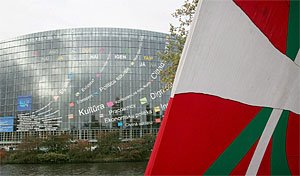
Finally on the 25th of October a debate took place in the European Parliament with hundreds of Basque pro-independence supporters rallying outside. A motion in favour of a democratic process in the Basque Country was passed with 321 votes in favour and 311 against.